Your company runs AI pilots. Some of them work. The question that matters is the next one: does that make you AI-native, or just busy?
Most leaders cannot answer it cleanly, because "AI-native" gets used for everything from a chatbot on the website to a full re-platforming. This page fixes a definition, gives you a scored self-check, and shows you, with sources, how few companies actually clear the bar. Then the honest part: the fastest way up is not another pilot.
What an AI-native company actually is (and what it isn't)
An AI-native company is one where AI is built into how the business runs, not bolted on. Remove the AI and the way the company operates breaks: decisions slow down, work stops flowing, people lose the answers they depend on. If you can pull the AI out and nothing important changes, you are not AI-native yet.
That test is borrowed from how investors judge AI-native products. CRV frames it as the difference between AI as "the architectural foundation on which the entire product depends" and AI as a feature: if you remove the AI and the product keeps working, it was never AI-native. Applied to a whole company, the same test asks whether AI is load-bearing in your operations or just present.
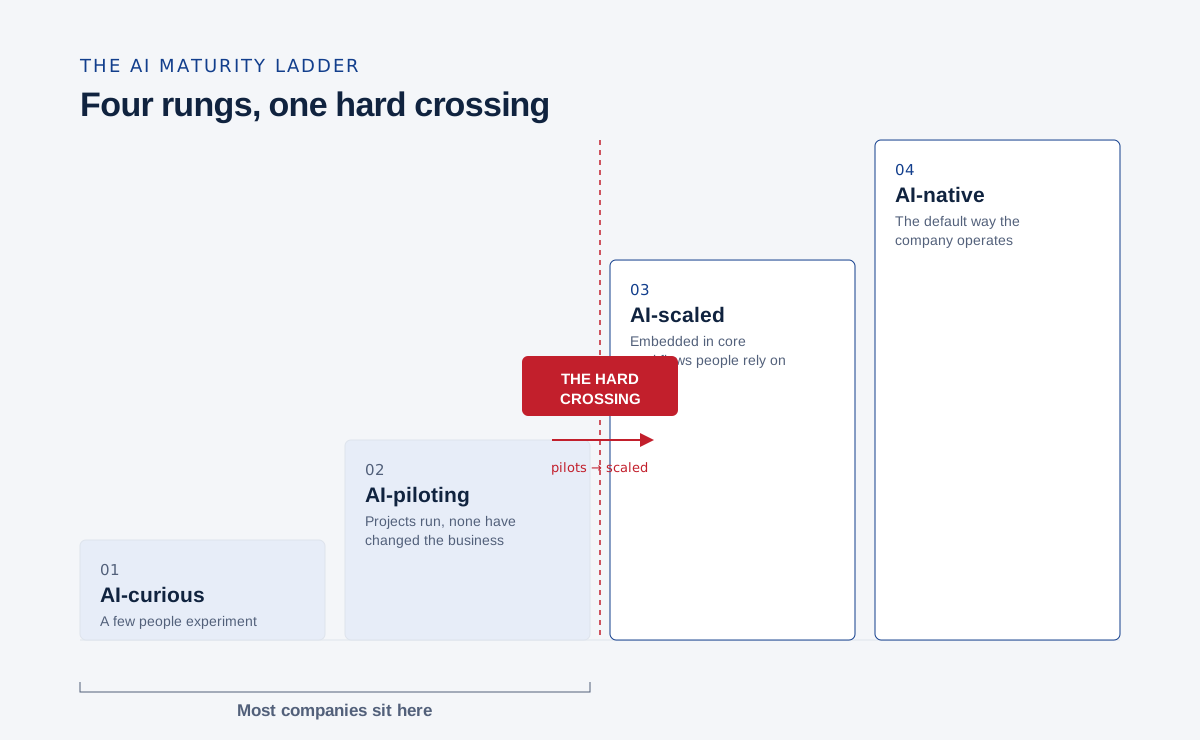
Think of it as a spectrum with four rungs:
- AI-curious: leaders are interested, a few people experiment, nothing is standard.
- AI-piloting: real projects are running, some show promise, none have changed how the business works day to day.
- AI-scaled: AI is embedded in core workflows that many people rely on, and the way work happens has changed.
- AI-native: AI is the default way the company senses, decides, and operates; removing it would break things.
A few clarifications, because the labels blur:
- AI-native vs AI-first vs AI-enabled. AI-enabled means you use AI tools. AI-first means AI is your default reach for new problems. AI-native means the business is built around it. Most companies calling themselves "AI-first" are AI-enabled with ambition.
- Pilots are not proof. A handful of successful pilots puts you on the ladder. It does not put you at the top. The jump from "our pilots worked" to "our company changed" is the whole game, and it is where almost everyone stalls.
Why almost everyone is stuck at "running pilots"
Here is the uncomfortable data. Adoption is near-universal; arrival is rare.
MIT CISR's Enterprise AI Maturity Model, built on a survey of 721 companies, sorts firms into four stages. Only 7% reached the top stage, "AI future-ready." The distribution is 28% / 34% / 31% / 7%, and the first two stages performed below their industry average on growth and profit, while the last two performed above. Being early is not neutral. It costs you.
The scaling gap shows up everywhere the data is clean:
- McKinsey's State of AI reports that the large majority of organizations now use AI, but only about a third have scaled it beyond a few pilots, and only a small share capture significant enterprise-level value. Use is common. Value is not.
- Gartner predicts over 40% of agentic AI projects will be canceled by the end of 2027, citing escalating costs, unclear value, and weak risk controls.
- MIT's NANDA report found roughly 95% of enterprise generative-AI pilots delivered no measurable P&L impact. That figure is contested (the sample is small and "failure" is defined loosely), but even the critics land on "most pilots don't move the numbers."
- S&P Global found 42% of companies abandoned most of their AI initiatives in 2025, up from 17% the year before.
Read together, one message: pilots are not progress. Running them is table stakes. Almost everyone is doing it, and almost no one has crossed to the other side. If you want the fuller breakdown of the failure numbers, we wrote a sourced piece on why AI projects fail.
The maturity ladder, translated for SMB and mid-market
MIT CISR's model was built for enterprises. Here is the same four-stage climb in plain terms for a company that does not have a Chief AI Officer.
- Stage 1: Experimenting. Individuals try tools. Nothing is shared, nothing is standard. The behavior that marks the jump out: leadership picks a few real problems worth solving.
- Stage 2: Piloting. Funded projects run against those problems. Some work. The trap: they stay projects. The behavior that marks the jump: you stop treating AI as a project and start changing how work is done.
- Stage 3: Scaled. AI is built into workflows people use every day, and roles change to match. This is where the money is.
- Stage 4: Native. AI is how the company operates by default. New processes assume it.
MIT CISR's most useful finding for a smaller company is where the money turns up. Companies in the first two stages performed below their industry average on growth and profit; those in the top two performed above it, so the line you cross to pull ahead falls between piloting (Stage 2) and scaled ways of working (Stage 3). The value is not in starting. It is in crossing.
The AI-native company checklist
Score yourself. One point per honest yes. No half-marks for "we're working on it."
Strategy & leadership
- We have a written view of where AI changes our business, owned by the top team.
- At least one senior leader uses AI directly in their own decisions, weekly.
Data foundation
- Our important company data is organized and reachable, not scattered across inboxes and drives.
- Someone can get a grounded answer from our own data in minutes, not days.
Workflows
- AI is built into at least one core workflow that many people depend on.
- If that AI went down tomorrow, people would notice and complain.
Decisions
- We routinely bring AI-grounded analysis into meetings where real calls get made.
- We check AI answers against source data instead of trusting or dismissing them blindly.
Talent & literacy
- Most of our team can use AI well for their actual job, not just chat with it.
- We hire and promote with AI capability in mind.
Governance & security
- We have a clear, followed rule for what data can go into which AI tools.
- We know where our data goes when we use AI, and we are comfortable with it.
Count your yeses:
- 0–3: AI-curious. You are experimenting. That is a fine place to start and a bad place to stay.
- 4–7: AI-piloting. Real work is happening. It has not changed how the company runs. This is the crowded rung.
- 8–10: AI-scaled. AI is load-bearing in parts of the business. You are past the hard jump.
- 11–12: AI-native. Remove the AI and things break. You are in the 7%.
Be strict. The whole value of this check is that it separates "running pilots" from "AI-native," and grade inflation defeats the point.
The dimension nobody scores: AI-native leadership
Look back at the checklist. The two hardest yeses for most companies sit at the top: a senior leader who uses AI directly, and AI-grounded analysis in the room where calls get made. That is not an accident.
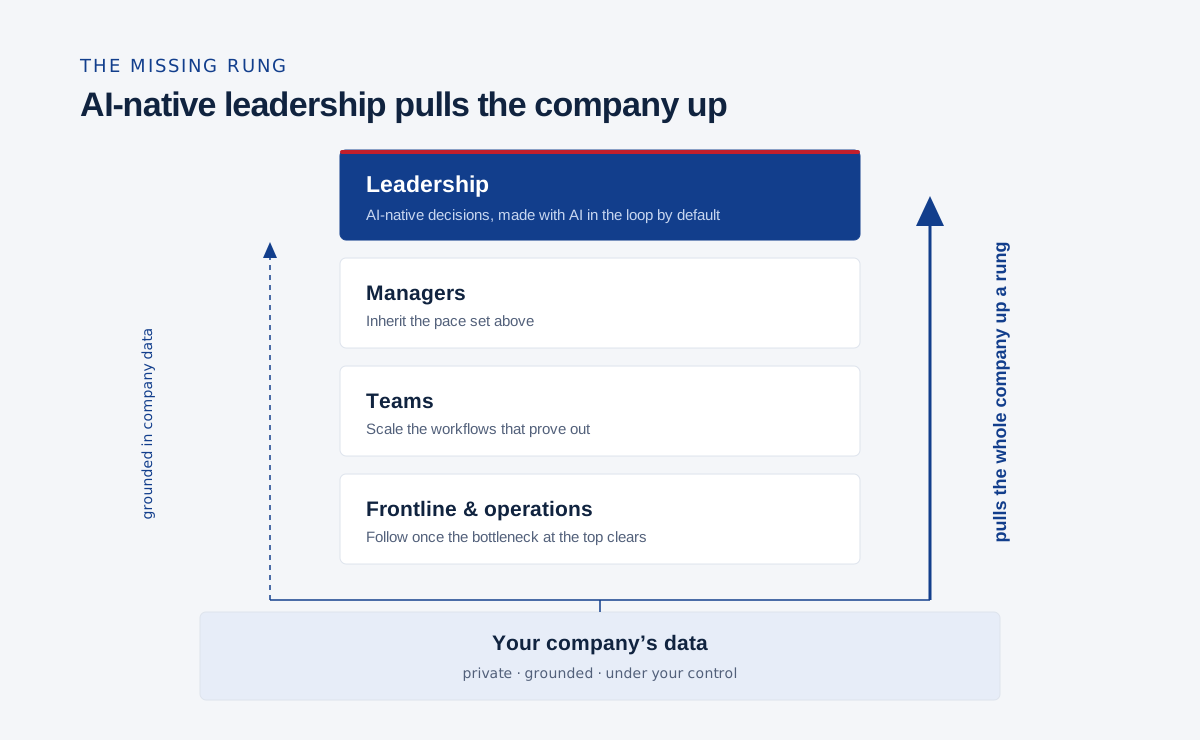
You cannot be an AI-native company with a pre-AI executive layer. If the top of the house still waits days for someone to pull the numbers, the whole organization inherits that pace no matter how many pilots run below. An AI-native executive, a leader who makes decisions with AI in the loop by default, is the missing rung on most maturity ladders.
And it is the fastest one to climb. Getting a whole company from Stage 2 to Stage 3 is slow, hard, organizational work. Getting one executive to ground their own decisions in company data is not. Point AI at your own numbers and it is your AI CEO seeing the whole company at once, your AI CFO answering before finance closes the month, or your AI CTO reasoning at architecture level. Same engine, different seat, and it starts with your ability to chat with your own data.
How to move up a rung without a two-year programme
The default move, a big, org-wide AI transformation programme, is exactly the thing the data warns against. Those are the projects Gartner expects to cancel and the ones S&P Global watched companies abandon. Betting your climb on a two-year steering-committee effort is betting on the coin flip that keeps landing tails.
The alternative is to start at the top and start small. Your own laptop, your own company's data, days rather than quarters. Ask the questions you would have waited two weeks and three meetings for. You are not launching another institutional programme. You are doing personally what the maturity data says separates the leaders: grounding real decisions in real data.
AI Board is your personal AI assistant that makes you an AI-native executive: an AI CEO, CFO and CTO on your own laptop, grounded in your company's data and getting sharper as your data grows. Private by design, fast, and ahead of the executives who wait.
Be honest about the limit. This does not make your whole company AI-native by itself; that still takes the scaling work, the change management, the data plumbing that moves an organization from Stage 2 to Stage 3. What it does is remove the bottleneck at the top so the rest can follow. On data: it is private by design, grounded in your own information rather than fed into a public model. That is a company brain you control. Here is what a company brain is and how we handle security.
FAQ
What is an AI-native company?
An AI-native company is one where AI is built into how the business runs, not added on top. The test: remove the AI, and the way the company operates breaks. If you can pull it out and nothing important changes, you are AI-enabled, not AI-native.
AI-native vs AI-first vs AI-enabled: what's the difference?
AI-enabled means you use AI tools. AI-first means AI is your default approach to new problems. AI-native means the business is built around AI so that it is load-bearing, so removing it would break operations. Most companies calling themselves "AI-first" are really AI-enabled.
What percentage of companies are AI-native?
Very few. MIT CISR found only 7% of enterprises reached its top "AI future-ready" stage. McKinsey reports only about a third of organizations have scaled AI beyond a few pilots, and only a small share capture significant value. Near-universal adoption, single-digit arrival.
Is my company AI-native if our pilots succeeded?
No. Successful pilots put you on the ladder, not at the top of it. MIT CISR's data shows companies only pull above their industry average once they cross from piloting (Stage 2) into scaled ways of working (Stage 3), changing how the company actually operates, not proving that AI can work in isolation. Pilots are table stakes, not the finish line.
How do we become an AI-native company?
Start where the odds are best: at the top, small, and fast. Ground your own leadership decisions in your company's data before launching an org-wide programme. The big programmes are the ones the data shows failing. Then scale the workflows that prove out. Leadership going AI-native first is the fastest rung to climb.
Score yourself honestly, and if the top two rungs of the checklist are your weakest, start there. See what an AI-native executive does with their own company's data →, request access.