The demo worked. The room nodded. Then, months later, nothing shipped.
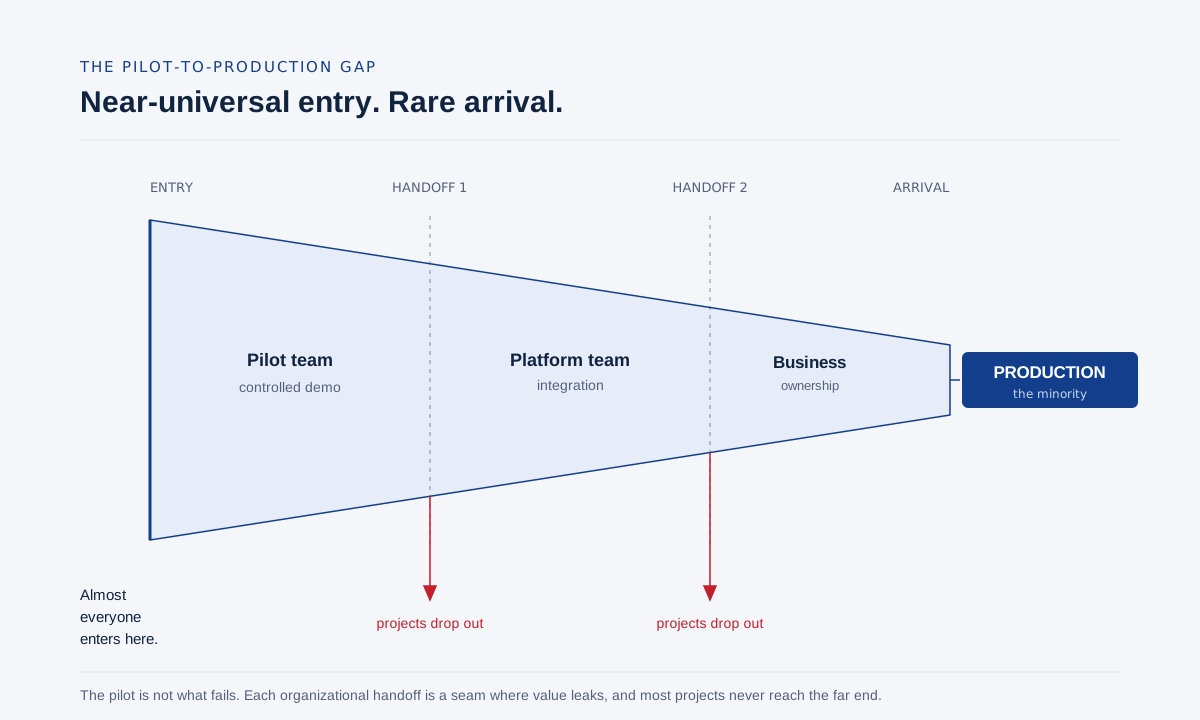
This is the most common AI story in the enterprise right now, and it is not a story about a weak model. The pilot did what it was asked. What killed it was the transition: the handoff from a controlled demo to something the business runs every day. That handoff has a name in the trade: the pilot-to-production gap. Most projects fall into it and never climb out.
Here is what the gap actually is, why your pilot cleared the demo but won't clear production, and the reframe that makes the gap disappear instead of asking you to survive it.
The pilot-to-production gap, in one number
Adoption is near-universal. Scaling is rare. That is the whole problem in one line.
McKinsey's State of AI 2025, covering nearly 2,000 respondents across 105 nations, found that around 88% of organizations now use AI regularly, but the majority are still experimenting or piloting; only about a third have begun to scale. For agentic systems the drop is steeper: just 23% report scaling one somewhere in the enterprise, while 39% are still only experimenting with agents.
The consulting numbers agree. Boston Consulting Group found only about 26% of companies have built the capabilities to move beyond proofs of concept and generate real value, meaning 74% struggle to scale. And Gartner reported that at least 50% of generative-AI projects get abandoned after proof of concept, a figure it had predicted at 30% a year earlier, and which came in worse.
The thesis of every one of those numbers is the same. The pilot is not what fails. The transition is.
Why the pilot worked and production won't
The demo ran on data that does not exist in production. That is the trap.
A pilot is built to impress. So it runs on a clean, curated slice: the good customers, the tidy quarter, the fields someone hand-fixed the night before. Production runs on everything: the duplicates, the blanks, the legacy exports nobody has owned since 2019. The model that looked brilliant on the cherry-picked set now has to reason over the real mess, and the answers get worse in ways the demo never revealed.
The data foundation is where this shows up first. Gartner predicts organizations will abandon 60% of AI projects unsupported by AI-ready data through 2026. And the organizations that do cross the gap are not smarter; they spend more on the foundation: up to four times more on data and analytics than the ones whose initiatives stall. The pilot never had to pay that tax. Production does.
The five things a pilot never has to solve
A pilot succeeds precisely because it is allowed to skip the hard part. Production is the hard part. Here is what waits on the other side of the demo:
- Legacy integration. The pilot pulled from an export. Production has to plug into the systems that actually run the company, live.
- Output quality at volume. Good answers on ten cases is not good answers on ten thousand. Edge cases that never came up in the demo become daily.
- Monitoring. A demo is watched by a proud team. Production has to catch its own drift and errors when nobody is looking.
- Named ownership. Someone has to own it Monday morning. Pilots are owned by the excitement of a launch; production is owned by whoever is on the hook when it breaks.
- Governance. Audit trail, failure protocol, escalation path. The pilot needed none of this. Production cannot exist without it.
Not one of those is a model limitation. They are organizational. This is the same pattern RAND identified when it found more than 80% of AI projects fail, about twice the rate of comparable non-AI IT, for reasons like misunderstanding the problem, poor data quality, and missing infrastructure. The technology is rarely the thing standing between your pilot and production.
Pilot purgatory is an operating-model problem
The reason the pilot has nothing to hand off to is that the organization was never built for production.
McKinsey's clearest finding is that the single biggest driver of EBIT impact from generative AI is redesigning the workflow, reworking how the work is actually done, not bolting a tool onto how it was already done. A pilot changes nothing about the workflow; that is why it is quick. Production requires the redesign, and the redesign is slow, political, and rarely funded.
Meanwhile the distance between the leaders and the rest keeps growing. BCG's 2025 research found the value gap widening, with only about 5% of companies qualifying as "future-built" and creating substantial value. Pilot purgatory is not a place your project is stuck temporarily. It is where projects go when the operating model around them was never rebuilt to receive them.
The scale tax: the cost of crossing the gap
Crossing the gap costs more than anyone budgeted, and the way you try to cross it changes your odds.
MIT's NANDA research found that buying from specialized vendors succeeds about 67% of the time, while internal builds succeed roughly a third as often. The instinct to build a production system in-house is, statistically, the instinct to stay in the gap. Add the 4x data-foundation spend the successful ones pay, and the true cost of productionization comes into focus: it is a multiple of the pilot, not an increment on it.
That cost is what kills projects late. Gartner expects over 40% of agentic-AI projects to be canceled by end of 2027, citing escalating costs, unclear business value, and inadequate risk controls. The pilot was cheap. The gap is expensive. Most budgets discover this halfway across.
The reframe: you don't have to survive the transition
Every framework you will read about this gap assumes the same thing: that you must build the bridge, staff it, fund it, and survive the crossing. There is a 4-stage operating model, a 7-root-cause checklist, an MLOps maturity ladder. All of them assume the institution has to scale.
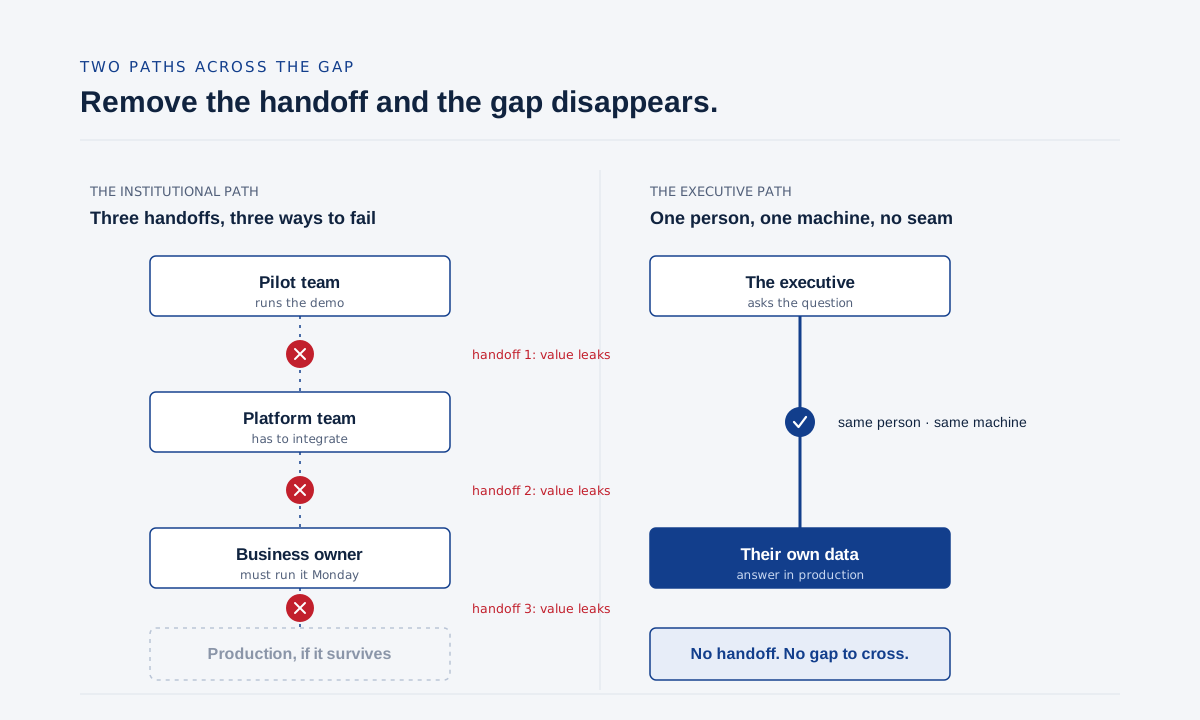
But look at why the gap exists at all. It exists because there is a handoff. The pilot team hands to the platform team, the platform team hands to the business, and value leaks at every seam. The gap is not a property of AI. It is a property of the handoff.
Remove the handoff and the gap disappears.
An individual executive working on their own laptop has no handoff to fail. There is no pilot team to disband, no platform team to onboard, no business owner to find. The person who runs the demo is the person who runs it in production, because it is the same person on the same machine. There is nothing to hand off, so there is nothing to drop.
If you want the full picture of why the institutional route fails, with every failure number sourced plus the finding about what employees are already doing without permission, that is why most AI projects fail. This piece is about the transition specifically; that one owns the whole graveyard.
What replaces the pilot
Start at the top, on the one machine you control.
Instead of sponsoring a pilot and waiting to see whether it survives productionization, point executive-grade AI at your own company's data, on your own laptop. No pilot committee. No platform handoff. No six-month rollout your board can cancel. Days, not a programme. You ask the questions you would have waited two weeks and three meetings for, grounded in your real numbers: an AI CEO view of the whole company, an AI CFO on the numbers, an AI CTO on the technical estate. Same engine, different seat, and it lives behind your own data, private by design.
This is what already happens under you. Your team went AI-native without asking, one private login at a time, skipping the pilot entirely. The reframe is to do the same thing deliberately, at the head of the table.
Be honest about the limit. This is not org-wide transformation, and it does not pretend to be. Getting your whole company across the pilot-to-production gap still takes the whole company: the workflow redesign, the data plumbing, the governance those McKinsey and Gartner figures describe. What starts on your laptop is one thing only: you, the individual executive, getting AI-native leverage this quarter without waiting for an institutional crossing that most institutions never complete.
FAQ
What is the pilot-to-production gap?
It is the failure point between a working AI demo and a system the business runs every day. The pilot succeeds because it runs on curated data and skips integration, monitoring, ownership, and governance. Production requires all of those, plus a handoff from the pilot team to a platform team to the business. Most projects fall into this gap. McKinsey found only about a third of organizations have begun to scale, despite near-universal adoption.
Why do AI pilots fail to reach production?
Because production demands things a pilot never has to solve: legacy integration, output quality at volume, monitoring, named ownership, and governance. These are organizational, not model problems. Gartner predicts 60% of AI projects unsupported by AI-ready data will be abandoned through 2026, and RAND found more than 80% of AI projects fail, roughly twice the rate of comparable IT.
What percentage of AI pilots reach production?
Estimates cluster low. Gartner reported at least 50% of generative-AI projects get abandoned after proof of concept. BCG found only about 26% of companies have the capabilities to move beyond proofs of concept. McKinsey found only about a third have begun to scale at all, and just 23% have scaled an agentic system.
How do you move an AI pilot to production?
The institutional route means building for integration, monitoring, ownership, and governance, and paying the data-foundation cost. Gartner found successful organizations invest up to four times more in data foundations. MIT found buying from vendors succeeds about 67% of the time versus roughly a third as often for internal builds. The alternative is to remove the handoff entirely and work AI-natively as an individual, where there is no transition to survive.
Should we still run an AI pilot?
For institutional AI, be clear-eyed: the pilot is the easy part and the transition is where most projects die. For an individual executive, skip the pilot framing altogether: working on your own data on your own laptop has no handoff, so there is nothing to productionize and nothing to drop.
You do not have to survive a transition that half of AI projects fail. Start where there is no handoff to fail: at the top, on your own data. See what an AI-native executive does with their own company's data →