You want the speed of AI on your real company numbers. You do not want those numbers sitting in someone else's training set.
That tension has a name now, and most of the pages that define it were written by companies selling servers. Here is the plain version, the evidence the glossary pages bury, and a way to work that does not require an IT project.
Private AI for business, defined
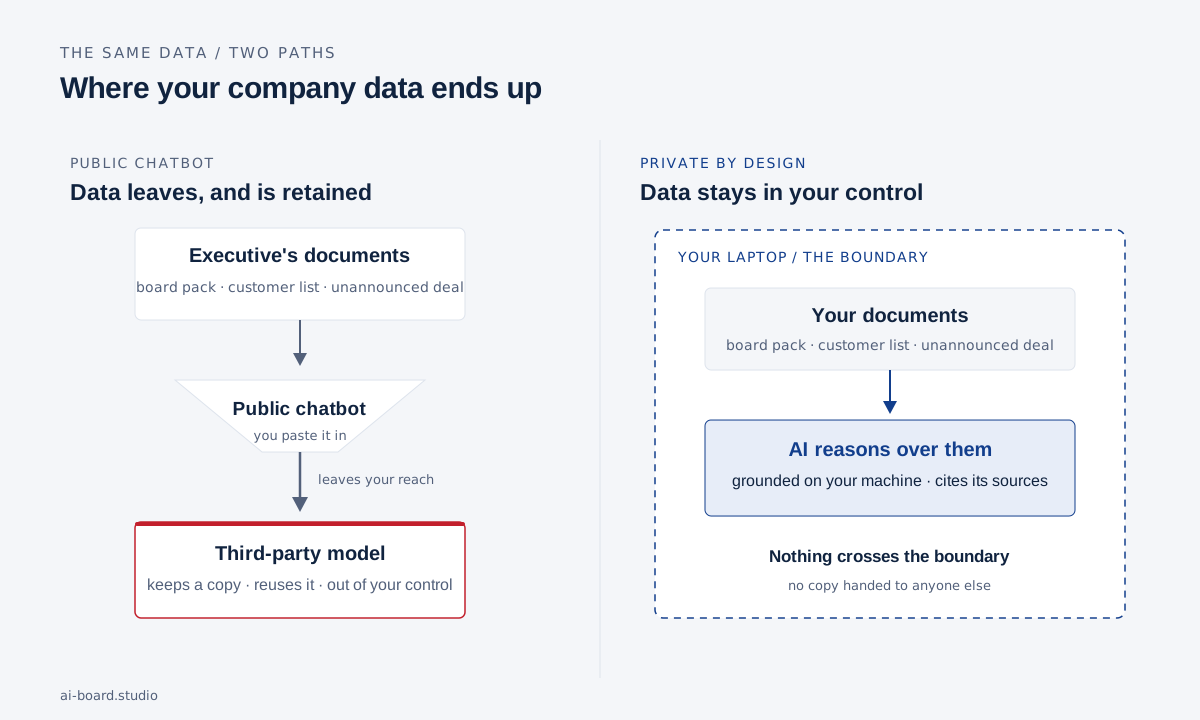
Private AI is AI that reasons over your company's own data while that data stays in your control, instead of being shipped to a public model that may keep it.
That is the whole idea. The enemy in the definition is specific: public chatbots retain and reuse what you type. Paste a board pack, a customer list, or an unannounced deal into a consumer tool, and you have handed a copy to a third party whose terms let them keep it. Private AI is the opposite arrangement: the model works over your data without that data leaving your reach.
Note what is not in the definition. It does not say "a server you bought" or "a private cloud you rented." Those are one way to get there. They are not the point. The point is control over where your data ends up.
The leak is already happening: the numbers everyone skips
The definition pages treat data leakage as hypothetical. It is not. It is measured, and the measurements keep getting worse.
Back in 2023, Cyberhaven found that 11% of everything employees pasted into ChatGPT was sensitive company data, and 4.7% of employees had pasted confidential data at least once. That was the early signal, when few people were paying attention.
By 2025 it was not a trickle. LayerX's Enterprise AI and SaaS Data Security Report found that 77% of employees paste data into GenAI tools, 82% of it from unmanaged personal accounts, and around 22% of it includes PII or payment data. Read that middle number twice: most of the pasting happens through personal logins your company cannot see, log, or govern.
And it carries a price. IBM's 2025 Cost of a Data Breach report found that breaches involving shadow AI cost about $670,000 more than the $4.44M average, that 20% of breached organizations were compromised through shadow AI, and that 97% of AI-breached organizations lacked proper AI access controls. The leak is not a future risk. It is a line item.
The two reflexes that both fail
Faced with those numbers, organizations reach for one of two reflexes. Neither is safe.
Reflex one: ban it. Cisco's 2024 Data Privacy Benchmark Study found 27% of organizations had banned GenAI over privacy and security risks, and yet employees kept entering non-public company information (48%) and employee data (45%) anyway. A ban does not stop the pasting. It pushes it off the corporate account and into the personal one, which is exactly the blind spot LayerX measured. You do not remove the risk. You remove your visibility of it.
Reflex two: tolerate it. Let people use whatever public tool they like and hope for the best. That is the status quo the numbers above describe: company data flowing into public models by default. It is the arrangement the glossary pages were written to make you nervous about, and they are right to.
Ban it and you lose sight of the leak. Tolerate it and you fund it. The problem with both is the same: they treat "should we use AI" as the question, when the real question is "on whose infrastructure does our data land."
Why 'private AI' has meant an IT project until now
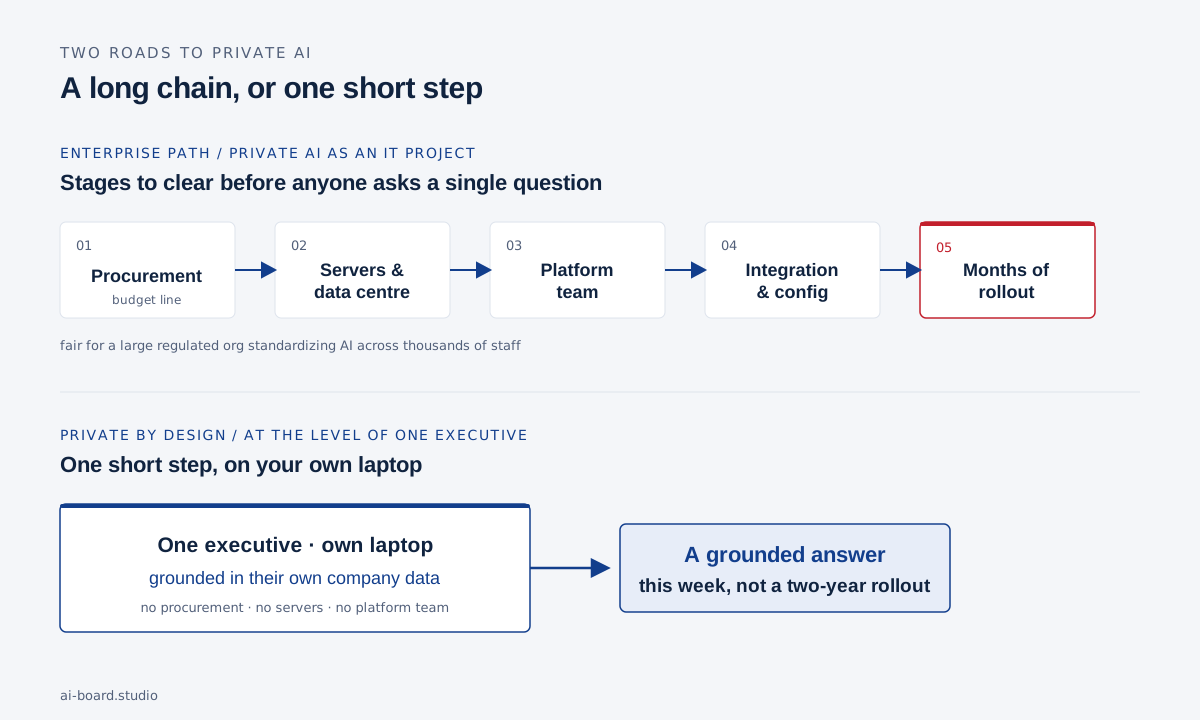
Ask the enterprise vendors what private AI is, and you get a building project. Private-cloud tenancy. On-premises servers. A platform team to run them. Months of procurement and integration before anyone asks a single question.
That framing is fair, and for a large regulated enterprise standardizing AI across thousands of staff, it may be the right one. If your definition of private AI is "infrastructure my organization owns end to end," then yes, it is a programme, with a budget line and a steering committee.
But look at who that answer serves, and who it leaves out. An executive who needs a grounded answer this quarter, who wants to interrogate their own board pack tonight rather than after a two-year rollout, cannot wait for that programme. And the good news is they do not have to. Privacy at the level of one person's work does not require the same machinery as privacy at the level of an entire org.
Private by design, at the level of one executive
Here is the reframe. Privacy is not a server you buy. It is a property of the design.
Private by design means the tool is built so your data works for you without being handed off. The AI reasons around your documents instead of swallowing them into a public model. It runs grounded on your own machine. And when it answers, it cites where the answer came from, so you can check it against the source rather than trust a black box.
That is a different claim from "we bought you a private data center," and it is an honest one. It sidesteps an infrastructure arms race: we are not going to out-spend hyperscalers on hardware, and we are not going to pretend we did. What we can do is design so that the executive's own data stays the executive's.
AI Board is your personal AI assistant that makes you an AI-native executive: an AI CEO, CFO and CTO on your own laptop, grounded in your company's data and getting sharper as your data grows. Private by design, fast, and ahead of the executives who wait.
The payoff is simple to state. You get executive-grade AI over your real numbers, on your own laptop, and the work stays where you can see it, not pasted into a public tool that keeps it.
The five questions to ask any AI vendor
Private by design is a claim, and claims deserve a test. Before you trust any AI tool with company data, make the vendor answer these, the same honesty test our security page walks through in full:
- Where does my data go when I ask a question? If the honest answer is "into our model provider's servers, under their terms," you are not working privately.
- Do you train on my inputs? "No" should be in writing, not implied.
- Can I see the source behind every answer? An answer you cannot trace is an answer you cannot defend.
- Who can read my data: you, or only me? The fewer parties, the smaller the surface.
- What do you deliberately not claim? A vendor that overclaims on security is telling you something.
On that last one, we hold ourselves to the same rule. What AI Board does not claim: we do not claim certifications we have not earned, and we do not promise an architecture we cannot guarantee. "Private by design" is a design commitment, stated plainly, not a compliance badge dressed up as one. If a vendor's security page reads like a wish list, treat it as one.
What private AI does not fix
Be honest about the boundary, because it is where the trust is.
Private AI at the executive level is your own leverage on your own data. It is not a governance system for your whole company. It will not stop the analyst three floors down from pasting a spreadsheet into a consumer chatbot on their personal phone. It does not replace an org-wide AI policy, a DLP rollout, or the security team's work. Those still have to happen, and the numbers above are exactly why.
What it does is remove you from the leak. It gives the one person who most needs grounded answers a way to get them without adding to the pile of sensitive pastes. That is a real, bounded thing. Getting the whole company private by design is a bigger job, and pretending otherwise would fail the honesty test we just described.
FAQ
What is private AI for business?
Private AI for business is AI that reasons over your company's own data while that data stays in your control, rather than being sent to a public model that may retain and reuse it. It can mean infrastructure an organization owns, but at the level of a single executive it means a tool that is private by design: grounded on your own machine, working around your data instead of shipping it out.
Can I run AI on my company data without it going to the cloud or OpenAI?
Yes. The category the industry calls a "local" or private-by-design approach keeps your prompts and documents on hardware you control, so working over sensitive files does not mean handing them to a public API. That is the difference between AI that swallows your data and AI that reasons around it while it stays with you.
Is private AI safer than ChatGPT for sensitive data?
For company data, the risk with a public chatbot is retention and reuse, measured behaviors rather than hypotheticals. Cyberhaven and LayerX both found large volumes of sensitive data flowing into public tools. A private-by-design tool is built so that data does not leave your control, which removes that specific exposure. It is not a blanket "safer"; it is safer against the leak that actually keeps happening.
What is the difference between "private as a promise" and "private by design"?
Private as a promise is a vendor telling you they will be careful with data that still passes through their systems. Private by design is an architecture where the data does not pass through in the first place: it works on your machine, grounded in your files, citing its sources. One asks for trust. The other reduces how much trust you have to extend.
How do I stop my team leaking data to public AI tools?
Banning it mostly moves the leak off accounts you can see. Cisco found sensitive data still went in after bans. A durable fix pairs a clear policy with a private, grounded tool people actually prefer, so the safe path is also the easy one. That is org-wide work; it starts with leadership modeling it. See how the shadow AI economy really works for the underlying pattern.
You do not need a private-cloud programme to stop being the leak. You need AI that works over your own data, on your own laptop, and keeps it there. See how AI Board keeps your company data private by design →, or read the full security honesty test, then chat with your own data.