By Jordi Daniels, founder of AI Board · ·
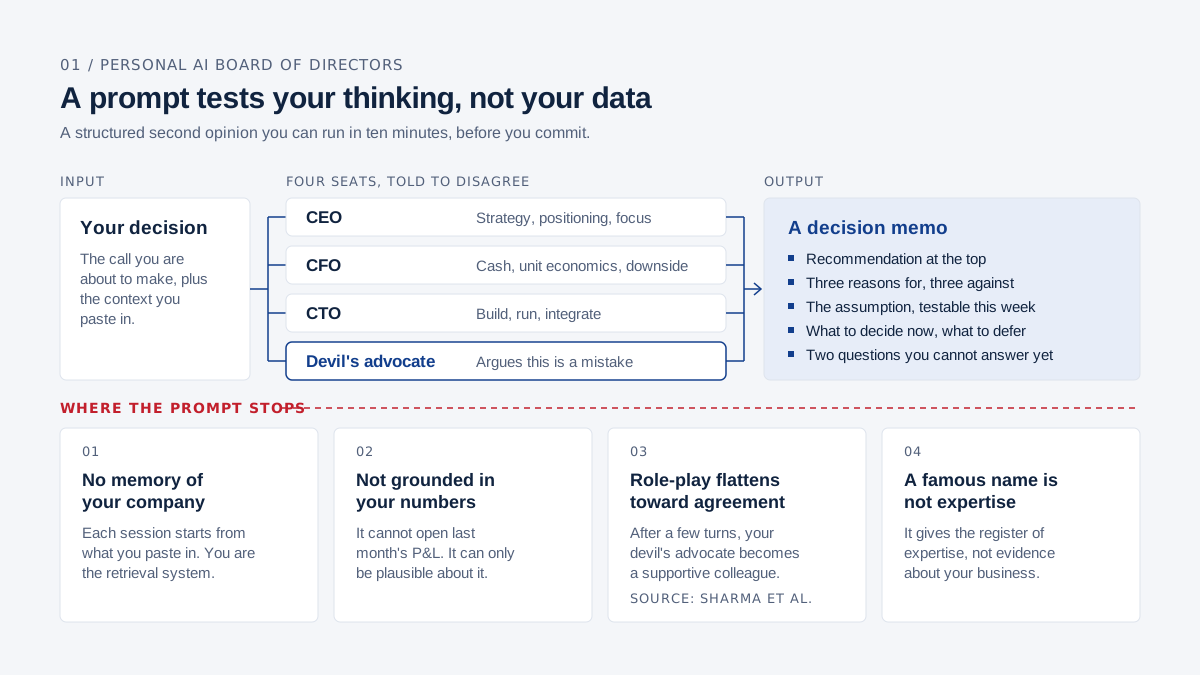
A personal AI board of directors is the practice of using AI to pressure-test a decision from several executive perspectives, a CEO lens, a CFO lens, a CTO lens and a deliberate opponent, before you commit to it. It has no authority and it is not a real board: it is a structured second opinion you can run in the ten minutes you actually have.
Most decisions at your level are not lost to bad analysis. They are lost to a missing angle. The strategy was sound and the cash flow was not checked. The numbers worked and nobody asked what it would cost to maintain. You knew the objection was coming and you never said it out loud to yourself first.
A real board catches that, which is why boards exist. Most people making the call do not have one available at 7am on the morning they have to decide. This post is about the substitute: what it is, a prompt that genuinely works, and the point where a prompt stops being enough.
For a working example, read Teus Louwerens' story: one assistant, three companies, grounded in his own files.
Where the idea comes from
The concept predates the AI version by about fifteen years. In 2010, Priscilla Claman argued in Harvard Business Review that the single-mentor model was finished, and that professionals should assemble a personal board of directors instead: several advisers, each strong in a different area, none of them expected to cover everything. The insight was about coverage. One brilliant mentor still has one point of view.
The AI version arrived recently and publicly. In July 2025, MIT Sloan Management Review published How I Built a Personal Board of Directors With GenAI, in which Vipin Gupta describes assembling a virtual advisory group in ChatGPT using personas modelled on figures such as Steve Jobs, Indra Nooyi and Nelson Mandela, each holding a defined domain, convened through structured prompts. His framing is worth keeping: the virtual advisers do not replace the real people, they are simply always available.
That article is, as we will get to, a fair illustration of both what the prompt approach gives you and what it cannot give you.
The prompt approach: a board you can run in ten minutes
Here is the honest version of the DIY route. Paste this into Claude or ChatGPT, fill in the bracketed parts, and you have a working personal AI board of directors. No product required.
You are my personal board of directors. Do not agree with me by default.
Your job is to find what I have missed before I commit.

CONTEXT
Company: [what you do, stage, headcount, revenue range]
The decision: [the specific call you are about to make]
What I believe: [your current position, in one sentence]
Constraints: [cash, runway, deadlines, people, contracts]
What I already know is uncertain: [be honest here]

SEATS
Take the decision through each seat in turn. Each seat gets its own
heading, argues in its own voice, and is allowed to disagree with the
other seats. Do not merge them into one balanced opinion.

1. CEO. Strategy, positioning, focus. Does this move us toward the thing
   we said we were building, or is it a detour dressed as progress?
   What are we saying no to by saying yes to this?
2. CFO. Cash, unit economics, downside. What does this cost in the worst
   realistic case, not the planned case? What would have to be true for
   the numbers to work, and how likely is each of those things?
3. CTO. Build, run, integrate. What is the real effort, including the
   part nobody scopes? What breaks in twelve months if we do this now?
4. Devil's advocate. Your only job is to argue this is a mistake. Take
   the strongest version of the case against, not a weak one. Name the
   single assumption that sinks the whole thing if it is wrong.

RULES
- If you need a fact I have not given you, ask me for it. Do not invent it.
- Mark anything you are inferring rather than reading from my context.
- No seat may say "it depends" without saying what it depends on.

OUTPUT: a decision memo, in this order
1. Recommendation: proceed / proceed with changes / do not proceed
2. The three strongest reasons for
3. The three strongest reasons against
4. The assumption this decision rests on, and how I could test it this week
5. What to decide now, and what to deliberately defer
6. Two questions I should be able to answer before I commit, and cannot yet
Two things make this work rather than produce a pleasant essay. The seats are told to disagree with each other, so the model cannot resolve the tension by averaging. And the output is a memo with a recommendation at the top, so it has to commit rather than survey.
Use it before the meeting, not after. The value is in the two questions at the end that you cannot yet answer.
The seat that earns its keep: making AI argue against your plan
If you only run one of these, run the devil's advocate on its own. Asking AI to argue against you is the cheapest correction available to a decision-maker, because it is the one thing nobody in your building volunteers to do.
The strongest structure for it is not new either. Gary Klein's project premortem, published in Harvard Business Review in 2007, works by assuming the failure has already happened and asking people to explain it. That flips the social dynamic: you are no longer asking a colleague to doubt you, you are asking them to narrate history. Models respond to the same flip.
Here is my plan: [plan].
Do not improve it and do not balance it.

Assume it is twelve months from now and this decision went badly.
Write the post-mortem: what went wrong, in what order, and what the
early warning sign was that I ignored this month.

Then list which of those warning signs I could actually check this week,
and how.
The last line is the one that changes behaviour. A critique you cannot act on is entertainment. A warning sign you can check on Thursday is a decision process.
Where the prompt approach stops
The prompt above is real and you should use it. It is also limited in four specific ways, and pretending otherwise would be the sales pitch rather than the truth.
It has no memory of your company. Every session starts from whatever you paste into it. You are the retrieval system, which means the board only ever sees the slice you thought to include. The angle you forgot is exactly the angle that was going to catch you.
It is not grounded in your numbers. It reasons about the company you described, and the company you described is the one you already believe in. A persona cannot open last month's P&L, reconcile two contradictory slides in the board pack, or notice that the pipeline figure moved. It can only be plausible about them.
Role-play flattens. The distinct voices hold for a few turns and then converge on the same agreeable register. This is not a prompting failure you can out-clever: research on sycophancy in language models by Sharma and colleagues found that state-of-the-art assistants consistently drift toward matching the user's stated view across free-form tasks, in part because human preference data rewards exactly that. Your devil's advocate becomes a supportive colleague well before the conversation ends.
A famous name is not expertise. A persona modelled on a great operator produces text in the register of a great operator. That is a genuinely useful thinking aid and it is not the same thing as a judgement grounded in evidence about your business.
None of that makes the prompt worthless. It makes it what it is: a good structure for thinking, running on a model that knows nothing about you.
The grounded version, and yes, this is our product
We build AI Board, and the product is named after this exact idea.
AI Board is not a persona role-play advisor. There is no simulated board of famous founders, no avatars, no assembled cast offering opinions out of thin air. That is the other category, and it is the one this article just described the limits of. AI Board is a personal AI assistant that runs on your own laptop and reasons over your own company's data, at CEO, CFO and CTO altitude. The multiple perspectives are lenses on real material, not characters. When it answers a question about runway, it has read the file. Your files become an indexed, answerable company brain; pointed at the whole business it is your AI CEO; and it is installed on your machine rather than sold as a chat window. The difference between the prompt and this is the difference between a convincing answer and a checkable one.
AI Board is your personal AI assistant that makes you AI-native: it runs on your own laptop, grounded in your company's data, and gets sharper as your knowledge grows. Private by design, reasoning at CEO, CFO and CTO level, so you ride the AI wave instead of swimming behind it.
FAQ
What is a personal AI board of directors?
A personal AI board of directors is the practice of using AI to pressure-test a decision from several executive perspectives before you commit: typically a CEO lens on strategy, a CFO lens on cash and downside, a CTO lens on build and maintenance, and a devil's advocate whose only job is to argue against you. It is a structured second opinion, not a governing body. The idea adapts the personal board of directors concept from career mentoring, argued in HBR in 2010, to a tool that is available at 7am.
Is there a Claude board of directors prompt I can just use?
Yes, and it is in this article. Copy the multi-seat prompt above into Claude or ChatGPT, fill in the bracketed context, and it will produce a decision memo with a recommendation, the case for, the case against, the load-bearing assumption, and the questions you cannot yet answer. Nothing else is required. If you only have two minutes, use the shorter devil's advocate premortem prompt on its own.
Is this the same as an AI board of directors for governance?
No, and the phrase collides with two other things. The European AI Board is an EU governance body of Member State representatives that coordinates implementation of the AI Act. Separately, "AI for boards" usually means board-portal and governance software that summarises packs and manages meeting logistics for a real board of directors. A personal AI board of directors is neither. It is one person, pressure-testing one decision, before anyone else sees it.
What are the limits of a personal AI board of directors?
Four, honestly. It has no memory of your company between sessions, so you are the retrieval system. It is not grounded in your actual numbers, so it can only be plausible about them. The distinct voices flatten toward agreement after a few turns, a documented pattern in research on sycophancy. And a persona modelled on a famous operator produces the register of expertise, not evidence about your business. Treat the output as a checklist of angles, never as a verdict.
When do you need more than a prompt?
When the answer has to be checkable. A prompt is enough for framing a decision, surfacing angles, and finding the objection you were avoiding. It stops being enough the moment the question is "what actually happened to our margin last quarter and why", because that requires the AI to read your files rather than your summary of them. The rule of thumb: prompts are good at questions about your thinking, and useless at questions about your data.
The prompt in this article is free, it works, and most people who try it will get real value from it. That is the honest ceiling of the DIY version: a sharper way to think, run by something that has never seen your company.
The version that changes your week is the same reasoning pointed at your own files. See what an AI Board does with your own company's data →
For your role: AI for strategy managers.