You keep hearing the same line. Your data has to be ready for AI first. It gets said at conferences, in vendor decks, by the consultant your board hired. It lands as a warning: do a big data programme, or the AI won't work.
Here is what almost nobody tells you. That warning is aimed at a different person: the head of a data-engineering org. If you are a CEO, CFO, or founder without a data team, "readiness" is a much smaller problem than the SERP wants you to believe. And it lives in a place you already control: your own files.
What "AI data readiness" actually means
AI data readiness is the condition of your data being fit for the specific question you want AI to answer: recent, relevant, and complete enough for that use, not a single, universally clean dataset.
That "fit for purpose" framing is Gartner's. Gartner defines AI-ready data as data that is representative of the use case at hand, "aligned to and qualified for" the specific AI you are building. Readiness is always relative to a question. There is no such thing as data that is "ready for AI" in the abstract, only data that is ready enough to answer this.
Notice what that rules out. AI-ready is not the same as clean. Clean data is tidy, deduplicated, well-formatted. AI-ready data can be messy in ways that don't matter for the question. It just has to contain the right context, in a form the model can read, close enough to current. McKinsey makes the same point from the other side: the objective is not perfect data before you start, it's defining what "good enough" means for each use.
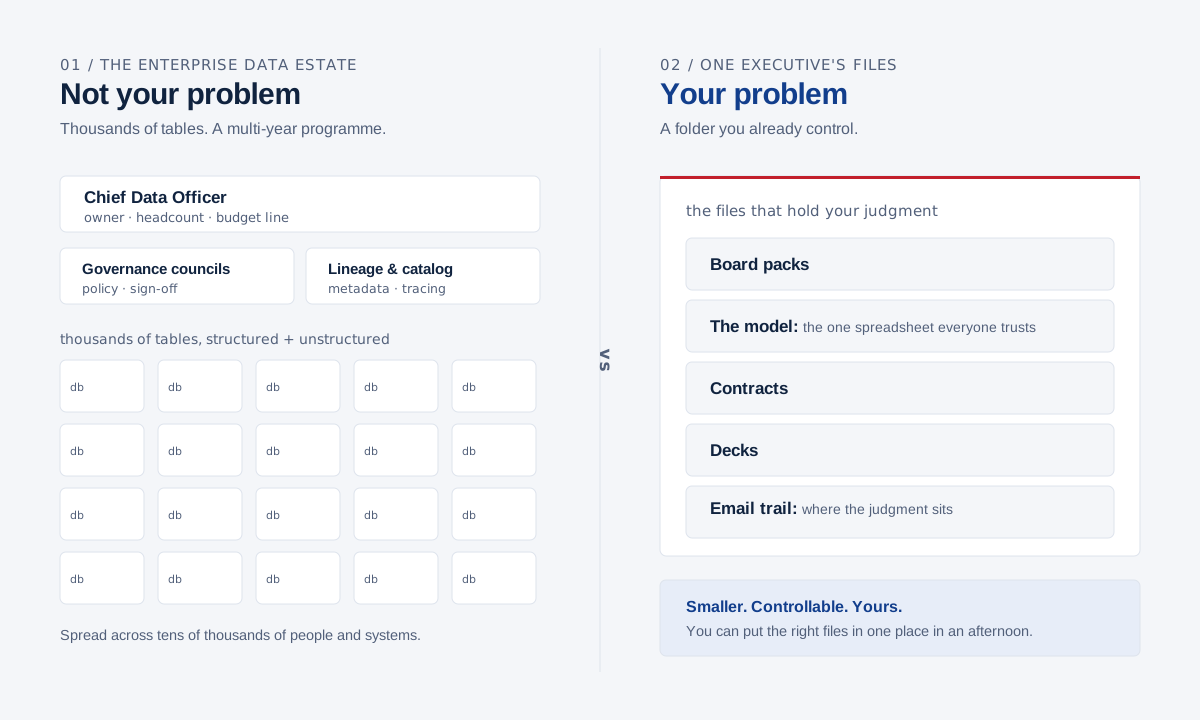
There are two very different audiences hiding inside that one phrase. One is the enterprise data estate: thousands of tables, structured and unstructured, that a Chief Data Officer has to govern. The other is you: one executive, with a set of files that hold your judgment. Every article ranking for this term writes for the first audience. This one is for the second.
The readiness gap is real, and it's not just you
Before we shrink the problem, be honest about how big it is at the enterprise scale, because the numbers are the reason everyone is nervous.
Only 7% of enterprises say their data is completely ready for AI. More than a quarter say it is not very, or not at all, ready. And 73% say their organization should be prioritizing AI data quality more than it does, per a 2026 study from Cloudera and Harvard Business Review Analytic Services. Nearly the same share found preparing data for AI genuinely hard.
Gartner puts a sharper edge on it. In a survey of data-management leaders, 63% of organizations either do not have the right data-management practices for AI or are unsure whether they do. And Gartner predicts that through 2026, organizations will abandon 60% of AI projects that are not supported by AI-ready data. The data problem is not a footnote to AI failure. It is a leading cause of it.
The money follows the same line. Organizations with successful AI initiatives invest up to four times more, as a share of revenue, in data foundations, governance, and change management than the ones with poor outcomes, Gartner reported in April 2026. Yet only 39% of technology leaders are confident their current AI spend will help the bottom line.
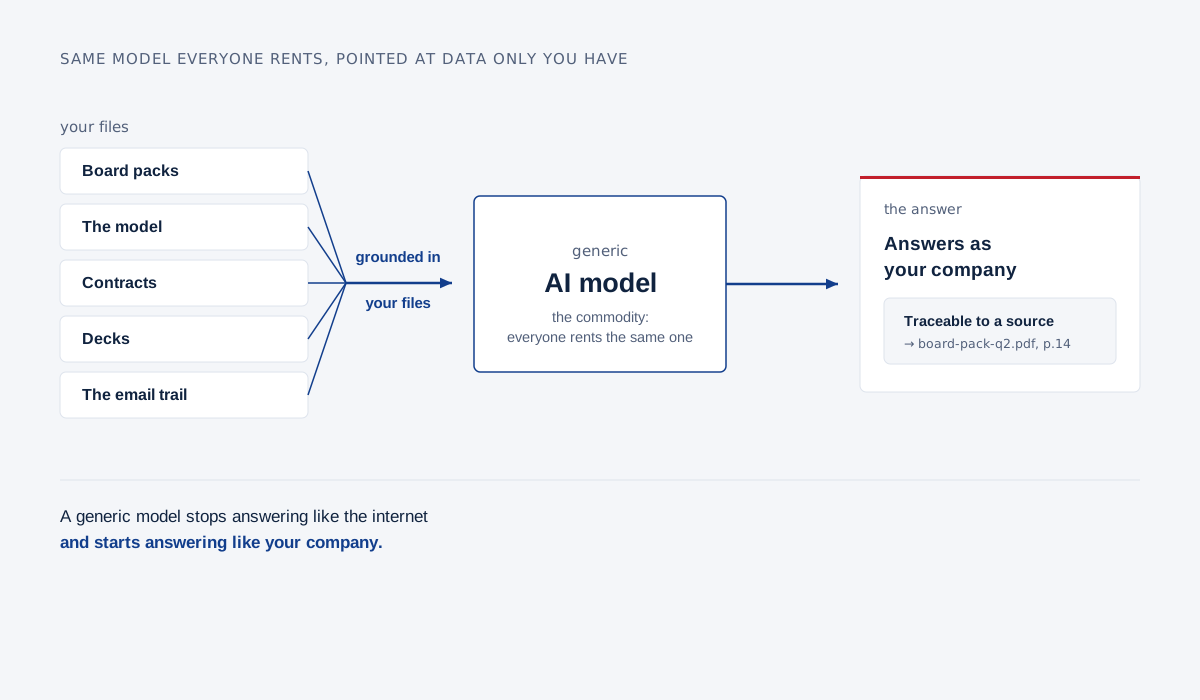
Read those together and one conclusion holds. The model is the commodity: everyone can rent the same frontier model by the token. The data is the differentiator. What separates a useful answer from a generic one is not the model. It is what the model is grounded in.
Why the enterprise playbook is a trap for you
So the natural move is to copy the winners. Build the data lake. Stand up a governance council. Buy the catalog, the lineage tooling, the ModelOps pipeline. That is what every ranking guide tells a data organization to do, and for a data organization it is right.
For you, it is a trap.
That programme is a multi-year effort with a headcount, a budget line, and a Chief Data Officer to run it. If you are a founder or a functional executive without a data org, "get your data ready" translated into that playbook means: wait years, spend heavily, and stay non-AI-native the whole time. You would be starting an institutional programme, the exact kind with the failure rates above, to answer questions you could answer this week.
The category error is scale. Enterprise readiness is about an entire data estate. Your readiness is about a set of documents. Those are different problems, and only one of them is yours. Don't inherit the CDO's job just because you share a piece of vocabulary. (This is the same trap that sinks so many corporate AI efforts; more on why AI projects fail.)
Your files are the moat
Here is where an executive's real data actually lives. Not in a warehouse. In the board pack you read last night. In the model, the one spreadsheet everyone treats as gospel. In the contracts, the deck history, and, most of all, the email trail where the actual judgment sits, the reasoning nobody ever wrote into a database.
That is unstructured data. And it happens to be the format AI is best at reading and enterprises are worst at using. Industry estimates from IDC hold that roughly 80% of enterprise data is unstructured (documents, decks, emails, contracts), and the large majority of it is never analyzed at all. "Dark data," the term goes: owned, stored, and never used.
At enterprise scale, corralling that is a nightmare: it is spread across tens of thousands of people and systems. At your scale, it is a folder. You know where your important files are. You can put the right ones in one place in an afternoon. The thing enterprises find hardest is the thing you find easiest, precisely because your corpus is small and you already command it.
And that is the whole game. Grounded in your files, a generic model stops answering like the internet and starts answering like your company. Same model everyone else rents, pointed at data only you have.
What "ready" means for one executive
Forget the CDO checklist. Here is the non-engineer version: five plain signals, none of which require data engineering.
- The right files are in one place. Not all your files. The ones that hold the answers you actually ask for: the pack, the model, the key contracts, the decks. Gathered, not scattered across six drives and an inbox.
- They're recent and version-correct. The AI reads what you give it. Give it the current model, not January's. Being ready means you trust that the file in the folder is the file.
- The context in your head is written down once. The half of every decision that lives only in your memory: why a number is what it is, what a clause really meant. Grounded AI can only use what exists in text. Writing it down once makes it reusable forever.
- There's a boundary on what stays private. Ready doesn't mean exposed. It means you've decided what the AI may see and what it may not, and that the sensitive material stays yours.
- It's good enough, not perfect. McKinsey's permission applies to you too: define good-enough for the questions you actually ask, then start. Waiting for perfect is how the years disappear.
That's it. No lineage graph, no metadata catalog, no council. Five signals you can check yourself.
How to get ready this week
The steps are small on purpose.
Pull the files that matter into one place: the pack, the model, the contracts, the decks, the email threads where the real reasoning lives. Make sure each one is the current version. Add a short note wherever the context lives only in your head. Then point executive-grade AI at that folder and start asking the questions you'd normally wait days and three meetings to get answered.
The point of grounding is not speed alone. It's that answers trace to a source. When the AI is reading your documents, a claim points back to the file it came from, not to a confident-sounding guess. That is the difference between a tool you can take into a board meeting and one you can't. (This is what "chat with your data" means in practice, and how a company brain is built.)
Be honest about the limit. This makes your data usable, fast. It does not fix org-wide governance, and it does not replace the enterprise's data programme. If your company needs lineage across ten thousand tables, it still needs the CDO and the multi-year effort. What starts on your laptop is one thing only: you, ready, while the institution catches up.
Where the AI sits once your data is ready
Once the files are gathered and grounded, the AI isn't a chatbot off to the side. It sits at your level, reading your company's real data, answering as your CEO, CFO, or CTO would, because it's grounded in the same material they'd use.
AI Board is your personal AI assistant that makes you an AI-native executive: an AI CEO, CFO and CTO on your own laptop, grounded in your company's data and getting sharper as your data grows. Private by design, fast, and ahead of the executives who wait.
Private by design. The data stays yours; the AI reads it where it lives, not in someone else's public model. If you want the fuller picture of the role this creates, here is what an AI-native executive is, and here is your AI CEO once your files sit behind it. How the boundary is drawn is covered under security.
FAQ
What does "data ready for AI" actually mean?
It means your data is fit for the specific question you want AI to answer: recent, relevant, and complete enough for that use, not a single, universally clean dataset. Gartner calls this "fit for purpose": readiness is always relative to the use case, never absolute. For an executive, it means the right files, current and in one place, with the context in your head written down.
How do I know if my data is ready?
Check five plain signals: the right files are gathered in one place; they're the current versions; the context that lives only in your head is written down once; you've set a boundary on what stays private; and it's good enough for the questions you actually ask, not theoretically perfect. If those hold, you're ready, with no data-engineering assessment required.
Do I need a data team or a data lake first?
No. Data lakes, governance councils, and ModelOps are the enterprise playbook for a Chief Data Officer governing thousands of tables. As one executive, your corpus is a folder of files you already control. Gartner's own data shows most organizations still lack those practices. Waiting for them is how you stay non-AI-native for years.
How much of my data can AI actually use?
Most of the data that matters to you is unstructured: documents, decks, emails, contracts. Industry estimates from IDC put unstructured data at roughly 80% of all enterprise data, and most of it is never analyzed. That's the format modern AI reads best, and at your scale you can actually gather it.
Is AI-ready data the same as clean data?
No. Clean data is tidy and deduplicated. AI-ready data is data that holds the right context for your question, in a readable form, close enough to current. It can be messy in ways that don't affect the answer. McKinsey's guidance is not to chase perfect data but to define "good enough" per use, then start.
Your files already hold the moat. The only question is whether you point AI at them this week or wait for a data programme that was never yours to run. See what an AI Board does with your own company's data →