Almost everyone at your level now uses AI. Almost nobody has made it a discipline.
Deloitte's 2026 Human Capital Trends found that 60% of executives regularly use AI to support their decisions, but only 5% consider themselves to be leading on AI and decision-making. That 55-point gap is the whole opportunity. Using AI is now table stakes. Turning it into a repeatable part of how you decide is what almost no one has done.
This is the how, not the what. If you want the definition (what the term means and why the room re-sorted), read what an AI-native executive is. This page assumes you already buy the case and want the operating manual: the shifts, the habits, and a concrete first 30 days.
One thing to settle up front. AI-native is a practice, not a title. You do not complete it. You start running it, and it compounds.
Start at the top, on your own data, not with a programme
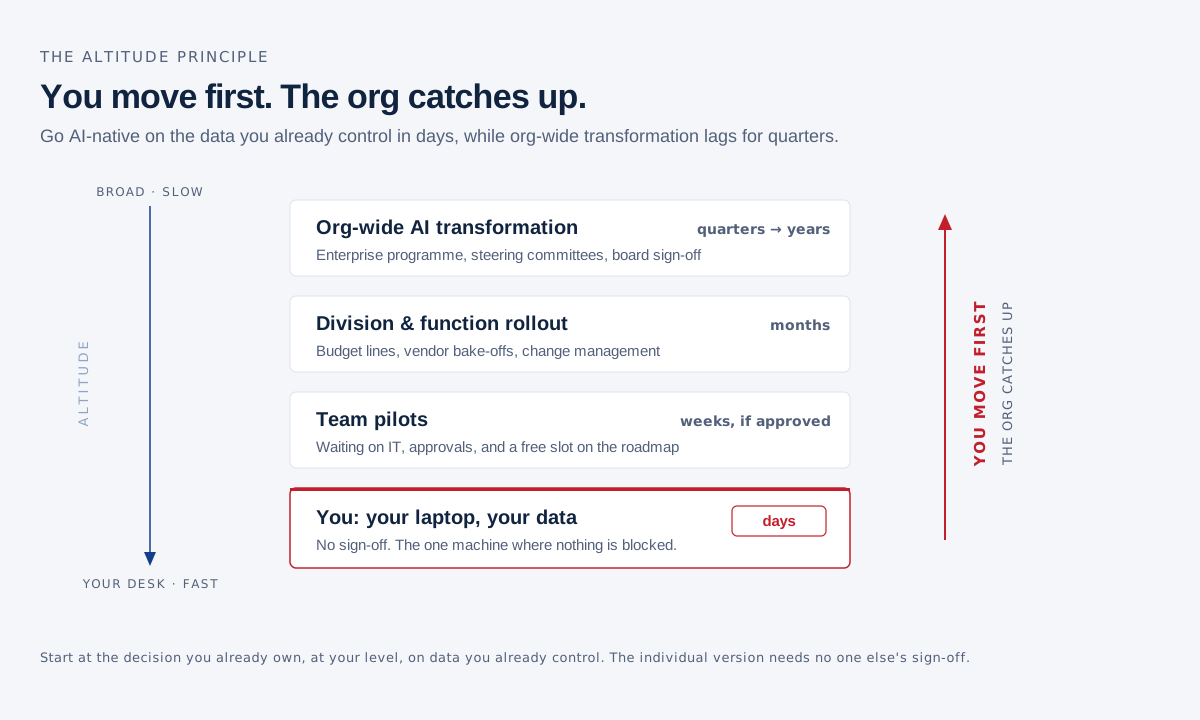
The move that makes you AI-native is not a rollout. It is you, your laptop, your data, in days.
Here is why you cannot wait for the org to get there first. McKinsey found that 88% of organizations now use AI in at least one business function, up from 78% a year earlier, but nearly two-thirds have not yet begun scaling it across the enterprise. Adoption is near-universal; scaling has barely started. And Gartner reports that 80% of CEOs say AI will force them to overhaul their operating capabilities. The institutional work is real, slow, and mostly ahead of everyone. If your plan is to become AI-native when the transformation finishes, you have chosen to be last.
So don't wait for it. The altitude principle is simple: start at the decision you already own, at your level, on data you already control. That is the one machine where nothing is blocked: your own. Point executive-grade AI at your own company's numbers and ask the questions you would normally wait two weeks and three meetings to get answered. No steering committee, no vendor bake-off, no line item a board can cancel.
This is deliberately not an IT programme; the failure rates on those are brutal, and this sidesteps them entirely by staying at your desk.
The five shifts that make you AI-native
Becoming AI-native is not new software. It is five changes in when and how you think.
-
Use AI earlier, when the decision space is still wide. Most people reach for AI to polish a decision they have already made. The shift is to bring it in at the top of the funnel, when options are open and framing still matters. That is where it changes outcomes, not just wording.
-
Stop consuming first-pass analysis. When a deck or a summary lands, do not accept it as finished. Interrogate it: what does this leave out, what would change the conclusion, which number is nobody flagging. First-pass work is now an input to question, not an answer to absorb.
-
Ground every answer in your own data. A generic model guessing about your business is worthless. The same model answering from your actual figures is a colleague. Grounding is the difference between plausible and true, and it is the difference between AI-native and merely AI-curious.
-
Orchestrate intelligence instead of being the smartest in the room. Your edge is no longer knowing the most. It is asking the sharpest questions and directing capability at them. The job shifts from having answers to conducting the search for them.
-
Make it standing prep, not an occasional reach. The occasional impressive prompt does nothing. A fixed habit, AI in the loop before every recurring decision, is what closes the Deloitte gap. Native means default.
If reading that list triggered a flicker of "everyone else already works this way and I'm behind", you are in good company, and the feeling is not evidence. Korn Ferry found 71% of US CEOs experience imposter syndrome, rising with the seat, not falling. The cure is not another course. It is agency: starting one small habit this week that you can actually check against real data.
Your first 30 days: a concrete operating plan
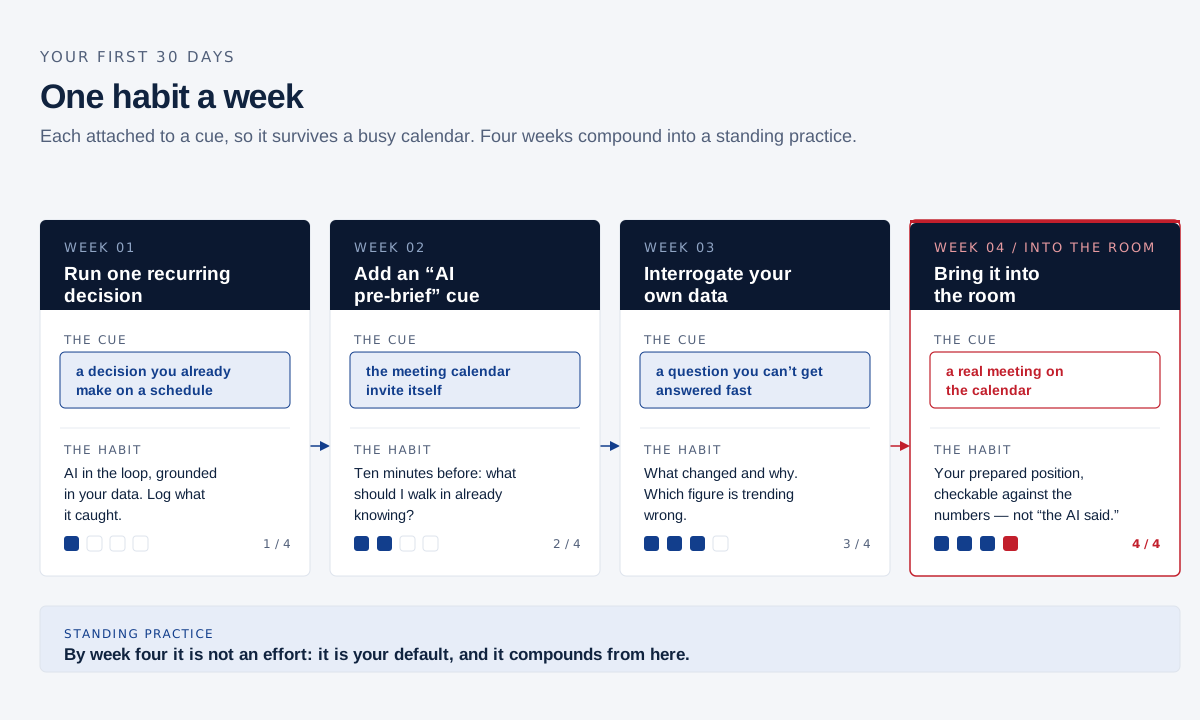
One habit per week. Each with a cue, so it survives a busy calendar. By week four you have a standing practice, not a good intention.
Week 1: Run one recurring decision with AI in the loop. Pick a decision you already make on a schedule: the weekly pipeline read, the monthly variance check, the roadmap risk call. Run it once with AI in the loop, grounded in your own data. Log the minutes it saved and the thing it caught. The point is a baseline you can feel.
Week 2: Add a standing "AI pre-brief" cue. Attach the habit to a trigger you can't miss. The cue is the calendar invite: before any meeting where you have to decide something, spend ten minutes asking AI what you should walk in knowing. The trigger fires the behavior. That is what makes it stick.
Week 3: Interrogate your own company data. Move from pre-briefing to investigating. Ask the questions you normally can't get answered without pulling someone off their work: what changed this month and why, which figure is trending wrong, what these two conflicting reports actually reconcile to. This is where grounding earns its keep.
Week 4: Bring an AI-grounded answer into the room. Take one answer you built on your own data and put it on the table in a real meeting, not as "the AI said," but as your prepared position, checkable against the numbers. This is the shift from private tool to how you lead. After this week, it is just how you work.
What to run it on: the questions each C-role should ask
The habit needs fuel: real questions about your own business. Here is where to point it, by seat.
As an AI CEO: interrogate the board pack before the board does. "What changed in the business this month, good and bad, and what caused it?" "Reconcile these two slides: one says pipeline is healthy, one says cash is tight. Which is right in the actual numbers?" See what an AI CEO does.
As an AI CFO: get to cash, margin, and variance before the monthly review even exists. "Where did margin move, and which line drove it?" "If the two late-stage deals slip, when does runway get uncomfortable?" See what an AI CFO does.
As an AI CTO: reason about delivery, incidents, and roadmap risk at architecture level. "Which workstream is most likely to miss, and what's the leading signal?" "What in this incident pattern should worry me that nobody has escalated?" See what an AI CTO does.
You do not need a management team to start; chatting with your own company data is one person asking one grounded question. But the same engine pointed at each seat is how a whole MT gets AI-native together, without a programme.
Do it without leaking your company
Here is the trap. The fastest way to feel AI-native is to paste a board pack into a personal chatbot. Don't. That is how confidential numbers end up training someone else's model, and it is exactly the shadow AI economy your own team is already running without permission.
The move is to out-level shadow AI, not join it. Work grounded in your own data, private by design, with your company's knowledge answerable to you without leaving your control. Being AI-native and being careful with your data are the same discipline done right, not a trade-off. See how the security model works.
What being AI-native does NOT mean
Being straight about the limits is what makes the term worth owning.
- It is not learning to code. The skill is judgment applied through AI, knowing which question to ask of your own data, not writing software.
- It is not autonomy or hand-off. You are keeping AI in the loop, not handing it the decision. Even Gartner's forecast has agentic AI making only about 15% of day-to-day decisions autonomously by 2028, up from 0% in 2024. The call stays yours.
- It is not an IT programme. No steering committee, no two-year roadmap, no budget line. This is your leverage this quarter.
- It is not persona role-play advisors. A simulated "board" of famous-founder avatars guessing out of thin air is a weaker, different category. Grounded in your real data beats a convincing persona every time.
- It is not a course you complete. There is no certificate. It is a practice you keep running, which is the whole point of the 30-day plan: to start the habit, not to finish a syllabus.
FAQ
How do you become an AI-native executive?
Start at your own level, on your own company data, in days, not with an org-wide programme. Run one recurring decision you own with AI in the loop, then add one habit a week: a standing pre-brief cue, interrogating your own data, and bringing a grounded answer into the room. The core shift is making AI standing prep before decisions, not an occasional reach.
How long does it take to become AI-native?
Days to start, weeks to make it a habit, not a year and not a programme. The 30-day plan above adds one habit per week until AI in the loop is your default, not an effort. It compounds from there. Unlike institutional AI transformation, which McKinsey shows most organizations have not yet scaled across the enterprise, the individual version is fast because it needs no one else's sign-off.
Do executives need to learn to code to be AI-native?
No. Microsoft's Work Trend Index found 66% of leaders would not hire someone without AI skills, but the skill they mean is judgment applied through AI, not programming. Being AI-native is knowing which questions to ask of your own data and reading grounded answers critically. No code, no prompt tricks.
What's the single first thing to do?
Take one decision you already make on a schedule and run it once with AI in the loop, grounded in your own company's data. Log what it caught and the minutes it saved. That one run is the baseline everything else builds on, and it is small enough to do this week.
You can start the first-30-days plan on your own laptop, on your own data, this week: no programme, no rollout, no waiting for the org to catch up. Request access to AI Board → and run your first grounded decision.