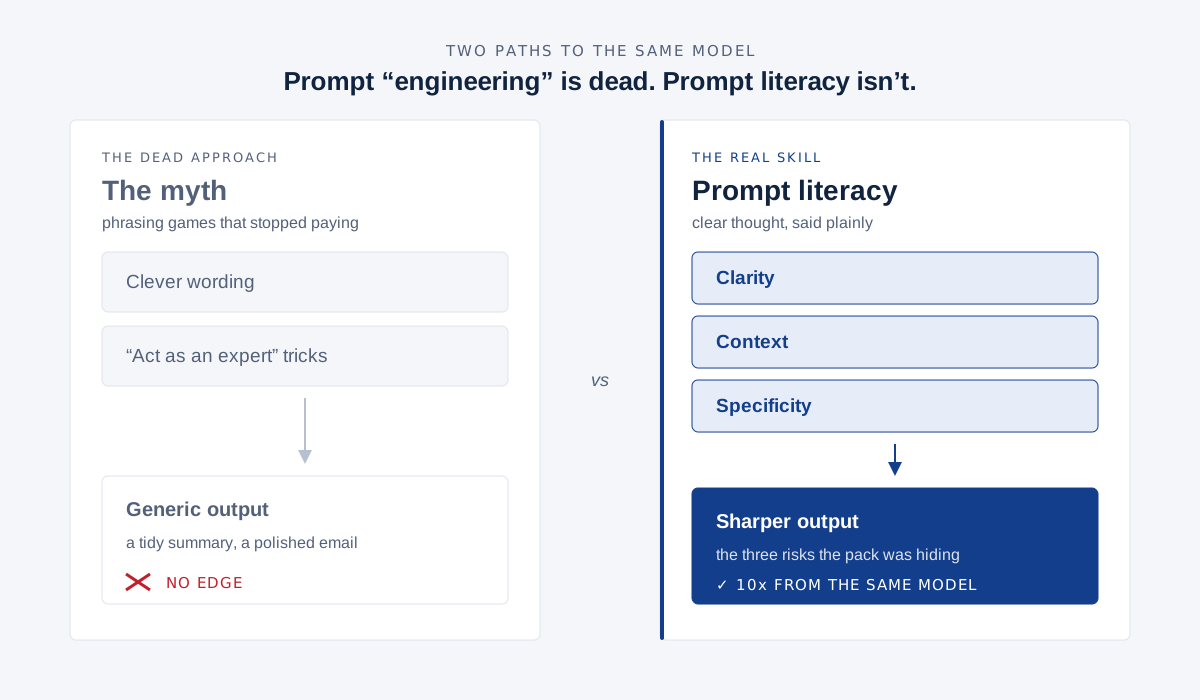
Two executives open the same AI. They feed it the same board pack. One gets back a tidy summary and a polished email. The other gets the three risks the pack is quietly hiding.
Same model. Same document. Same afternoon. A 10x gap in what came out.
The difference was not access. Both had it. The difference was the question, and the level it was asked from. That level is the whole skill, and almost nobody teaches it.
Prompt "engineering" is the wrong word
The word makes it sound technical, like there is a syntax to memorize. There isn't. Not anymore.
The era of clever wording is over. Ethan Mollick, who studies this at Wharton, puts it plainly: the tricks matter far less now than giving the AI good context, the way you would brief a capable assistant. The models got good enough that phrasing games stopped paying.
Even the most famous trick is a myth. Telling an AI to "act as an expert" did not reliably improve accuracy in Wharton's tests: the expert label made no difference to correctness in most cases and models. Personas shape tone and framing. They do not make the answer more right.
So drop "engineering." The real skill is prompt literacy: clarity of thought, the right context, and specificity. Wharton's own six tactics for better results come down to that: specify the outcome, provide context and constraints, iterate, ask for diverse approaches. None of it is a magic phrase. All of it is thinking clearly and saying what you actually want.
For an executive, that is good news. You already do the hard part for a living: you know which question matters. The skill transfers.
Asking at your altitude
Here is the part the course pages miss. A CEO, a CFO and a CTO can be handed the exact same numbers and should ask structurally different questions of them.
A CEO asks where the whole company is drifting and which two slides contradict each other. A CFO asks what breaks the forecast and when cash gets uncomfortable. A CTO asks what the architecture cannot carry and where the technical debt is compounding. Same data underneath. Three altitudes above it.
This is not a metaphor. It is the operating logic of the AI CEO, AI CFO and AI CTO views: same engine, different seat, each asking at the level of its decision.
The research points the same way. MIT Sloan's work on inquiry, drawing on Hal Gregersen's "question burst" method, found that around 85% of the time, generating questions without rushing to answers reframes the problem or reveals a new path. AI should amplify that inquiry, not replace it. The executive's edge was never the answer. It was knowing which question to ask, and from how high.
Prompt literacy for executives is just that instinct pointed at a model. You ask at your altitude, and the machine works at your altitude with you.
The context that makes questions land
A perfect question against generic data gives you a generic answer. This is why copy-paste prompt libraries disappoint. A "CEO prompt template" pulled off a listicle has nothing underneath it: no pipeline, no forecast, no last month's numbers. It can only tell you what a CEO somewhere might want to hear.
The highest-value context is not a cleverer instruction. It is your own company's real data. Point the same question at your actual board pack, your actual cash position, your actual roadmap, and the answer stops being a template and becomes a briefing.
That is the structural move: put your numbers underneath the question. Chatting with your own data is what turns prompt literacy from a party trick into a working tool, and it stays private by design, on your own machine, not typed into a public chatbot. The question is the altitude. The data is the ground. You need both.
The FUD turn: you already use AI more than your team
Here is the trap, and it is a comfortable one.
You are probably not the laggard. BCG's 2025 AI at Work study, covering over 10,600 workers across 11 countries, found roughly 88% of leaders are regular AI users, against about 51% of frontline employees. There is a silicon ceiling, and you are above it.
Which sounds like safety. It isn't. Because heavy use is not the same as high-altitude use. McKinsey found leaders are the biggest barrier to scaling AI, not employees, and that leaders underestimate their own people badly. The C-suite guesses about 4% of employees use gen AI for a third of their daily work; roughly 13% actually do. Your team is about 3x more AI-fluent than you think.
Meanwhile the real adoption went underground. MIT's GenAI Divide report found around 95% of enterprise gen AI pilots delivered no measurable P&L impact, while employees in about 90% of companies already use personal AI tools for work. The programmes stalled. The individuals went AI-native anyway.
Put it together and the exposure is not that you don't use AI. You do, daily. The exposure is that you use it shallowly, on summaries and drafts, while someone a level down, or a peer at the next table, is asking harder questions of better-grounded data and pulling ahead one meeting at a time.
A working altitude ladder
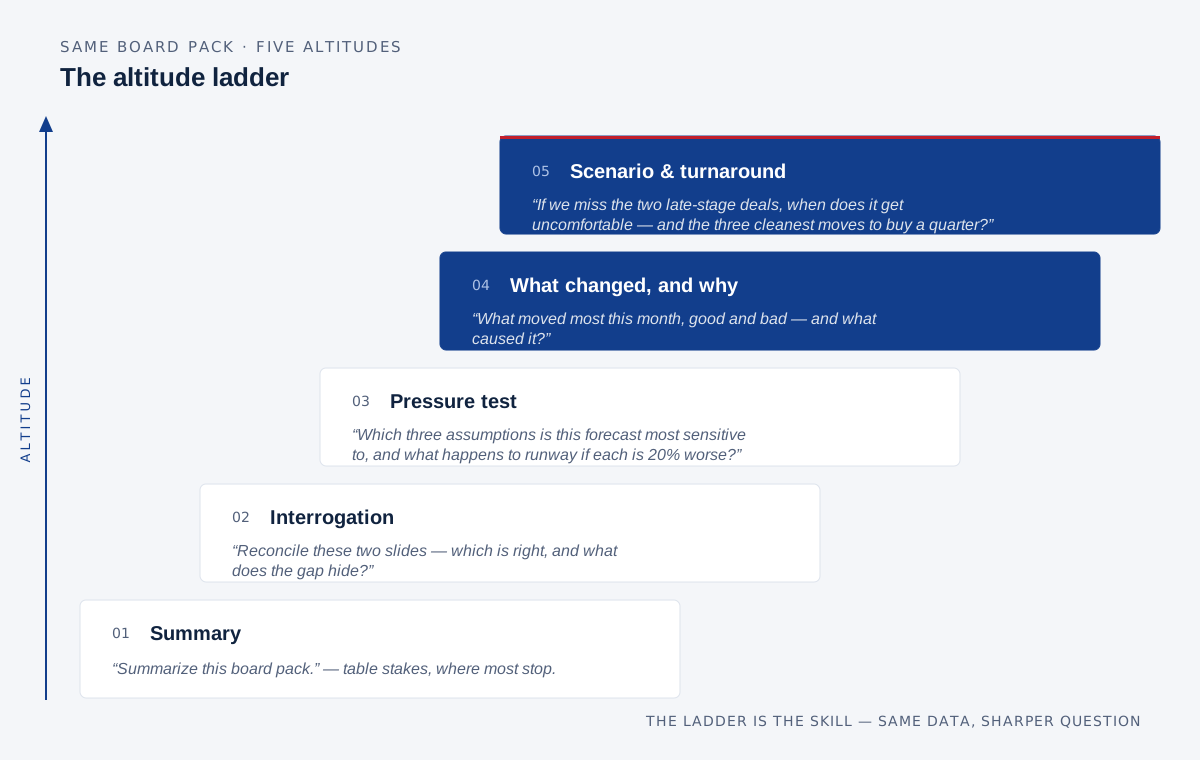
The fix is a ladder, not a template. You climb from summary toward strategy, and each rung is a sharper question of the same material. Grounded in Wharton's tactics, namely specify, contextualize and iterate, here is what the climb looks like.
Rung one, summary. "Summarize this board pack." Fine. Everyone gets this. It is table stakes and it is where most executives stop.
Rung two, interrogation. "Reconcile these two slides: sales says pipeline is healthy, finance says cash is tight. Which is right in the actual numbers, and what does the gap hide?" Now you are asking the AI to find contradiction, not just compress text.
Rung three, pressure test. "Pressure-test this forecast. Which three assumptions is it most sensitive to, and what happens to runway if each one is 20% worse?" You are stress-testing judgment, not reading it back.
Rung four, what changed and why. "What moved most in the business this month, good and bad, and what caused it?" You walk into the room already knowing, instead of scheduling a meeting to find out.
Rung five, scenario and turnaround. "If we don't close the two late-stage deals, when does it get uncomfortable, and what are the three cleanest moves to buy a quarter?" Now the AI is expanding your option set at the altitude where you actually decide.
Same board pack the whole way up. The ladder is the skill.
What better questions still can't buy
Be honest about the ceiling, because that honesty is the point.
Prompt literacy raises how good your analysis can get. It does not raise your judgment, and it never touches ethics, conflict, or trust. The model can lay out five scenarios and rank them. It cannot tell you which one you can live with, which one your board will forgive, or which one keeps faith with the people who work for you.
AI expands the field of options. The executive still decides why, and what for. A better question gets you a better map. It does not walk the road, carry the accountability, or sit across the table when the decision goes wrong. That part is still yours, and it should be.
That is not a weakness in the tool. It is the shape of the job. The AI-native executive asks better and decides better because the two are different acts, and only one of them can be delegated to a model.
How to become AI-native without an IT programme
Notice what this skill does not require. Not a course, not a certificate, not a two-year transformation with a steering committee.
It requires your own laptop, your own data, and the habit of asking at your altitude, in days, not a rollout. You point executive-grade AI at your real numbers, you climb the ladder, and you stop being the shallow-use executive while someone below you went AI-native without asking. This is the operating skill underneath the identity: if the AI-native executive is the who, prompt literacy is the how. And once your data sits behind it, it is also what an AI board member does: it asks the questions you would have waited two weeks for.
AI Board is your personal AI assistant that makes you an AI-native executive: an AI CEO, CFO and CTO on your own laptop, grounded in your company's data and getting sharper as your data grows. Private by design, fast, and ahead of the executives who wait.
FAQ
What is prompt engineering for executives?
It is the skill of asking AI the right question at the level of your decision, grounded in your own company's data. The name is misleading; there is no syntax to memorize. What moves the answer is clarity, context, and specificity, not clever wording. For an executive it means interrogating your board pack, forecast, or roadmap directly instead of accepting a generic summary.
Do executives really need to learn it?
Yes, but not as a technical course. Executives already use AI more than their teams. BCG found about 88% of leaders are regular users versus 51% of frontline staff. The risk is not non-use. It is shallow use: summaries and drafts, while a peer asks harder questions of better data. Learning to ask at your altitude is the difference.
What makes a good executive AI prompt?
Context and specificity, not a magic phrase. Wharton's tactics, namely specify the outcome, provide constraints and iterate, beat any template. The single biggest lever is the data underneath: a sharp question against your real numbers gives a briefing; the same question against nothing gives a platitude.
How is an AI CEO's prompt different from an AI CFO's?
Altitude. Given the same numbers, a CEO asks where the whole company is drifting and which slides contradict each other; a CFO asks what breaks the forecast and when cash gets tight; a CTO asks what the architecture cannot carry. Same data, different level of question, which is exactly what the AI CEO, AI CFO and AI CTO views are built for.
Why do my AI answers feel generic?
Almost always because there is no real context underneath the question. A prompt pulled from a template has no pipeline, forecast, or last month's numbers behind it, so it can only return something generic. Point the AI at your actual company data and the same question returns something specific: a briefing instead of a guess.
The tool is the same for everyone now. The question is not. The executives pulling ahead are not the ones with better access. They are the ones asking at their altitude, of data that is actually theirs.
See what an AI-native executive does with their own company's data →, and meet your AI CEO.