By Jordi Daniëls, founder of AI Board ·
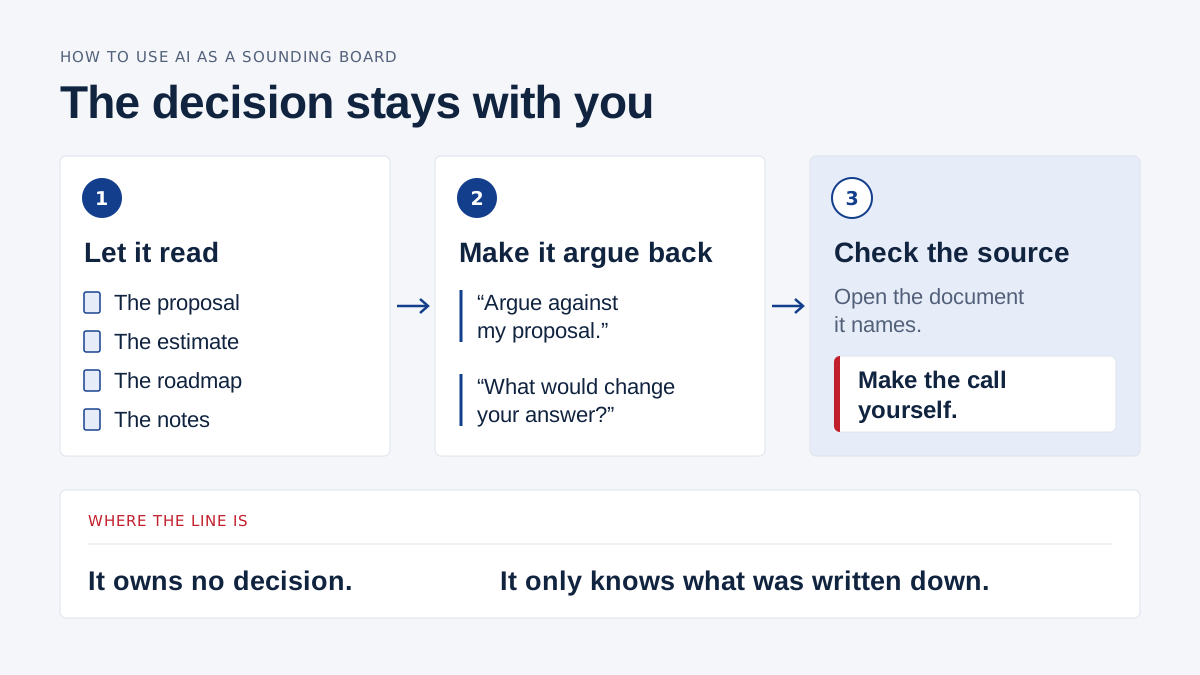
AI works as a sounding board for a technical decision when three things hold. It has read the documents behind the decision. You ask it to argue against you. And you check every answer against its source. The decision stays with you.
An assistant that has read those files before you ask is what we call an AI CTO. This piece is about the method, whichever assistant you use.
It is written for two readers. The CTO who wants a second reader before a commitment. And the founder who has to decide on an agency proposal without a technical co-founder.
What should you let it read?
Let it read the documents the decision rests on, and nothing it does not need. A sounding board that only has your summary can only agree with your summary.
| Document | What it lets you ask | Leave out |
|---|---|---|
| An agency proposal and your scope document | What is missing, and which line items carry most of the cost | Contracts whose confidentiality clause forbids sharing |
| An estimate with earlier sprint notes | What drives the estimate, and how earlier estimates held up | Notes on the performance of individual developers |
| A cost report or a year of cloud invoices | Which items drive the increase, and since when | Payment details and account numbers |
| A pentest report | Which findings matter for this decision | Credentials, keys and exploit details found in the test |
| The roadmap | What this decision moves or blocks | Customer data your contracts do not let you share |
| Architecture notes and earlier decisions | Why you chose what you chose, and what has changed since | Passwords, API keys and connection strings |
| Vendor terms | What happens to your data, and which notice periods apply | Nothing: these are public, or yours |
Where those files go depends on your plan. On Claude Team and Enterprise, conversations are not used for training by default.
On Pro and Max you choose that yourself in the privacy settings, since 28 August 2025 (both checked on 26 October 2026).
For any other assistant, check the vendor's own data terms before you paste in a proposal or a contract.
Keep the documents for one decision together. In Claude, a project holds the files and the conversations about them in one place. You then do not explain the context again for every question.
In AI Board the documents sit in your company brain, which lives on your own laptop. You choose if a question goes to a cloud model or stays fully local.
The details are on how AI Board handles your company data.
Which questions make it argue back?
Ask questions that make it disagree with you, test assumptions or name what would change its mind. A question that invites agreement usually gets it.
That tendency has been measured. Anthropic researchers found that five leading AI assistants consistently showed sycophancy: answers that match the user's beliefs rather than the truth (published 23 October 2023).
Write "I think this proposal is fine", and you have told it which answer you prefer. So give it the documents and the question first, and your own view last, or not at all. Then work through these eight.
- "Argue against my proposal." It turns easy agreement into a list of objections you can check.
- "What must be true for this estimate to hold?" An estimate is a set of assumptions. This question puts them on the table.
- "What changed since the previous proposal, and why did the estimate move?" The change is often where the cost sits.
- "Which three questions will the agency find hardest to answer?" You take those into the meeting.
- "What do we give up with this option?" Every technical choice closes another one. Make it name which.
- "Set what was delivered against what the roadmap promised." A progress report describes effort. This compares the outcome with the plan.
- "What would change your answer?" It shows how firm the answer is, and what you should check first.
- "What do other users say about this vendor?" If your assistant can search the web, it brings back forum threads, not only feature lists. Read the threads it cites.
CTOs interviewed by LeadDev work the same way. One asks a model to act as a "judge" and tell him what is wrong with his idea (LeadDev, 16 October 2025). He does that for presentations and for architecture choices.
Another had a model find user feedback on tools he was weighing; his team then asked the vendors different questions before buying.
Ask for the source with every answer: the document, and the page or line. An objection you cannot trace back to a file is a guess.
A worked example: the agency proposal
Say an agency sends you a proposal to rebuild your customer portal. This is how the questions line up against your files. The answers depend on what those files say, so the last column is the part you do yourself.
| Your question | What it reads | What you check yourself |
|---|---|---|
| "Compare this proposal with our scope document. What is missing?" | The proposal and the scope document | Whether a missing item was forgotten, or left out on purpose |
| "What drives this estimate, and what must be true for it to hold?" | The estimate and earlier sprint notes | Whether those assumptions match what your team knows |
| "Set what the agency delivered last quarter against what the roadmap promised." | Delivery notes and the roadmap | Whether a gap was the agency's, or came from a late decision on your side |
| "Should we build this, or buy a product that already does it? Argue both sides." | Your requirements, vendor quotes and past decisions | The trade-off itself, set out in build vs buy AI |
After those four questions you have a list of points to raise, each with the document it comes from. What you do not have yet is a decision. That is the next step, and it is yours.
Is it bad to use AI as a sounding board?
No, as long as you can check the answer and you make the decision yourself. It goes wrong when it decides for you, or when you use it on a question it cannot answer well.
The second risk is measurable. Researchers at Harvard Business School ran an experiment with 758 BCG consultants in 2023, with GPT-4, published in Organization Science in 2026.
Consultants who used AI on a task outside what AI does well were "19% less likely to produce correct solutions" than those without AI.
On tasks inside that frontier, consultants with AI did more work, faster.
Developers draw the line in the same place. In the Stack Overflow Developer Survey 2026, 48% say they trust AI when they can easily validate the answers.
That is the case for a sounding board that names its sources: you can validate every point. Four limits remain.
- It owns no decision. It cannot sign off an architecture or answer for an outage.
- It only knows what was written down. A decision made in a hallway is not in the answer.
- It misses people and politics. LeadDev describes an engineering leader who used AI to refine a proposal for a new org model (LeadDev, 16 April 2025). Senior engineers soon saw the cultural friction it had overlooked. Test a plan that touches people with people.
- Someone still has to own the result. As a fractional CTO guide puts it, "someone still needs to own architecture, data access, quality, and maintenance".
If you want a person who decides with you, the page on the AI CTO compares it with a fractional CTO and a CTO coach.
Before your next technical decision: a short routine
- Collect the documents. Put the proposal, the estimate, the roadmap and the notes for this one decision in one place.
- Ask what changed. Since the last proposal, the last estimate or the last decision on the same subject.
- Ask for the counter-argument. Before you share your own view.
- Ask what would change the answer. Then check that point first.
- Check the source and decide. Open the document it names. Make the call yourself, and write down why, so the next decision has a record to read.
If you are the sitting CTO, AI for CTOs applies this to four questions that come back every week.
FAQ
Is it bad to use AI as a sounding board?
No, if you give it the documents, ask it to argue back and check its answers against the source. It is bad when you let it decide, or when you cannot check what it says.
Can you use ChatGPT as a sounding board for technical decisions?
Yes, any capable assistant. What counts is that it reads the actual documents, that you ask it to disagree, and that you check the answer. Read the data terms of your plan before you share a proposal or a contract.
How do you stop it from just agreeing with you?
Give it the documents and the question before your opinion. Ask it to argue against your proposal, and ask what would change its answer. If it still agrees with everything, ask for the three weakest points in your plan.
What should you never paste in?
Passwords, API keys and other credentials, personal data about staff, and customer data your contracts do not let you share. Set this down once in a short policy; the AI policy example is a two-page start.
Pick the next technical decision on your desk, collect its documents and start with the first question: argue against my proposal.