By Jordi Daniëls, founder of AI Board ·
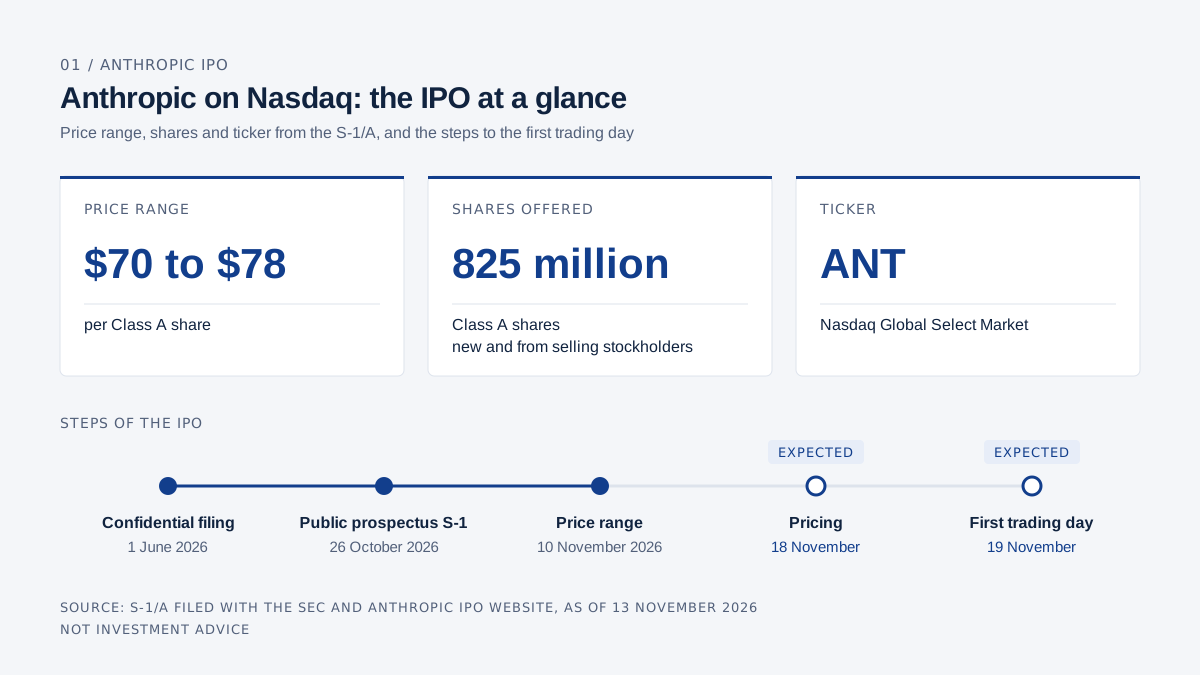
Anthropic, the company behind Claude, plans to start trading on Nasdaq under the ticker ANT on 19 November 2026, with a price range of $70 to $78 per share. The offering covers 825 million Class A shares, most of them new, and the final price is expected on 18 November. At that range Anthropic is worth roughly $916 billion to $1.02 trillion on shares outstanding after the offering, and up to $1.4 trillion once every option and restricted stock unit is counted. Sources: the amended S-1 filed with the SEC and CNBC, as of 13 November 2026. This is not investment advice.
AI Board runs on Claude, so I watch Anthropic closely as a supplier. I am not a licensed investment adviser and I won't tell you whether to buy, sell or wait. Every number here comes from Anthropic's SEC filings or from other sources I link to.
The figures are a snapshot of 13 November 2026. The final price is set at pricing and can land inside, above or below the range.
If your company uses Claude, I found no announced change to Claude plans tied to the listing. The S-1 does say Anthropic has changed its pricing models before and expects it may do so again. If you are weighing Claude against Microsoft's tools, read Claude vs Microsoft 365.
What is known about the Anthropic IPO on 13 November 2026?
Anthropic set a price range of $70 to $78 per Class A share on 10 November 2026, in Amendment No. 2 to its S-1, for a listing on the Nasdaq Global Select Market. The first public S-1, filed on 26 October, left the share count and price blank.
| Item | Status on 13 November 2026 | Source |
|---|---|---|
| Exchange and ticker | Nasdaq Global Select Market, ANT | S-1/A, cover page |
| Price range | $70 to $78 per Class A share | S-1/A, cover page |
| Shares offered | 825,000,000: 801,351,354 new shares from Anthropic, 23,648,646 from selling stockholders | S-1/A, cover page |
| Underwriters' option | up to 123,750,000 additional new shares | S-1/A, The Offering |
| Size of the offering | $57.75 billion to $64.35 billion before the option | my calculation from the S-1/A; CNBC gives $64.35 billion at the top |
| Concurrent private placement | $26 billion of non-voting Class N shares at the IPO price | S-1/A, cover page |
| Retail investors | up to 20% of the shares offered, in the US and other countries | S-1/A, Underwriting |
| Underwriters | 22 banks, led by Goldman Sachs and Morgan Stanley | S-1/A, cover page |
| Roadshow | from 10 November | Anthropic's IPO website, filed with the SEC |
| Pricing | expected 18 November (US Eastern time) | same |
| First trading day | expected 19 November | same |
| Last private round | Series H, $65 billion at $965 billion post-money, 28 May 2026 | Anthropic |
Who are the cornerstone investors?
Seven chip and cloud companies have agreed to buy $26 billion of Class N stock at the IPO price, closing right after the offering. Press reports call them cornerstone investors; the S-1 calls it a concurrent private placement. At the $74 midpoint, the S-1/A allocates it like this:
| Buyer | Amount at $74 per share |
|---|---|
| about $10 billion | |
| Nvidia | about $10 billion |
| AMD | about $2.5 billion |
| Broadcom | about $1 billion |
| Micron | about $1 billion |
| Microsoft | about $1 billion |
| TSMC | about $0.5 billion |
These shares are not registered in the offering and are not covered by the underwriters' lock-up, but they are restricted securities that can only be resold under SEC rules. Microsoft, which sells Copilot, is putting about $1 billion into Anthropic here.
What is still unconfirmed?
Demand figures come from anonymous sources only. Bloomberg reported on 12 November that the book was about six times oversubscribed, and CNBC wrote on 10 November that it was already covered within the range. Anthropic has not confirmed either, and the filed range on 13 November is still $70 to $78.
The price can still move above the range. The European retail prospectus sets a maximum of $120 per share for retail orders in Europe.
How much is Anthropic worth, and why do the numbers differ?
At the range, Anthropic is worth $916 billion to $1.02 trillion on shares outstanding and up to $1.4 trillion fully diluted. The gap comes down to which shares you count.
Shares outstanding. The S-1/A puts total shares of all classes after the offering and placement at 13,086,672,593, assuming the $74 midpoint. Times $70 that is $916 billion; times $78 it is $1.02 trillion. That is my own arithmetic. The count shifts slightly with the price, because $26 billion buys more Class N shares at a lower price.
Fully diluted. Add employee options and unvested restricted stock units and the same filing adds more than 2.8 billion shares: 1.77 billion from options with a weighted average exercise price of $2.91, and just over 1 billion from RSUs. On that basis CNBC gets to $1.405 trillion at the top of the range.
Last private round. In May 2026 Anthropic raised $65 billion at a $965 billion post-money valuation. Post-money figures usually count all shares, so compare that number with the diluted one.
A headline saying "$1 trillion" and one saying "$1.4 trillion" can both be right.
What does the S-1 say about revenue and losses?
Revenue is growing fast and the net loss is large, but most of that loss is an accounting remeasurement rather than cash leaving the business. These figures come from the risk factors in the S-1/A.
| Period | Revenue | Net loss | Of which fair-value changes on notes, derivatives and SAFEs |
|---|---|---|---|
| 2023 | $41 million | $1.5 billion | $1.0 billion |
| 2024 | $386 million | $8.3 billion | $5.4 billion |
| 2025 | $4.6 billion | $42.0 billion | $34.3 billion |
| Nine months to 30 September 2026 | $33.2 billion | $104.0 billion | $94.3 billion |
Anthropic has convertible notes outstanding. When its valuation rises, those notes are worth more on the balance sheet, and the increase is booked as a loss. The operating loss for the first nine months of 2026 was $1.3 billion.
In the third quarter of 2026, revenue was $17.0 billion and the operating loss $567 million. Anthropic also reports Adjusted Operating Income of $2.5 billion, a 15% margin, which is its own non-GAAP measure.
Other numbers from the filing:
- Run-rate revenue was about $81 billion on 31 October 2026. Anthropic calculates it as usage fees over the trailing 28 days times 13, plus monthly subscription fees times 12, and says it is not a forecast.
- In the first nine months of 2026, 79% of revenue came from usage-based fees and 21% from subscriptions. 44% was sold through cloud providers' marketplaces.
- More than 11,900 business customers each paid $100,000 or more over the trailing twelve months.
- On 30 September 2026 Anthropic held $95.6 billion in cash and cash equivalents and $36.3 billion in short-term investments.
How is Anthropic governed?
Anthropic is a public benefit corporation with five share classes, in which an independent trust and the co-founders hold control while public shareholders hold mainly economic rights. Everything in this section comes from the S-1/A.
A public benefit corporation (PBC) is a Delaware company with a stated public purpose. Anthropic's is "the responsible development and maintenance of advanced AI for the long-term benefit of humanity". Its directors must balance shareholders' financial interests, the interests of people materially affected by the company, and that purpose.
The Long-Term Benefit Trust (LTBT) is a body of financially disinterested trustees with backgrounds in AI safety, national security, public policy and social enterprise. It has five seats, one of them currently vacant. Through a single Class T share it elects the directors who make up a majority of the board.
| Class | Held by | Votes | Economic rights |
|---|---|---|---|
| A | the public and existing holders | one vote per share | yes |
| N | mainly strategic partners | none, except where the law requires | yes, same as Class A |
| T | the Long-Term Benefit Trust, one share | elects the board majority | no |
| F | the Founder LLC of the seven co-founders, one share | 50.1% of votes on general matters | no |
| E | employees other than the co-founders | only on certain limited matters | no |
Class N converts to Class A when sold to an unaffiliated third party. Counting the Founder LLC, the co-founders will hold 61.3% of the voting power after the offering, which makes Anthropic a "controlled company" under Nasdaq rules, exempt from some governance requirements.
In its risk factors Anthropic says Class A holders may have little say over major decisions, including a change of control, and that the multi-class structure may keep the stock out of some indices.
How does an IPO work, step by step?
An IPO runs from a confidential filing through a price range, roadshow and pricing to the first day of trading, followed by months in which insiders cannot sell. Anthropic's dates are visible in its EDGAR filing list.
| Step | What happens | Anthropic |
|---|---|---|
| Confidential filing | The SEC reviews a draft before anything is public | first draft on 1 June 2026 |
| Public prospectus | Financials, risks and governance go public in the S-1 | 26 October 2026 |
| Price range | Company and banks set a range and a share count | 10 November 2026 |
| Roadshow and bookbuilding | Banks pitch to investors and collect orders with sizes and prices | from 10 November |
| Pricing | The book closes and the final price is set | expected 18 November |
| Allocation | Banks decide who gets how many shares; with excess demand, many get less than they asked for | retail up to 20% |
| First trading day | The opening price comes from supply and demand on the exchange | expected 19 November |
| Underwriters' option | If banks sell more than the base deal, they can buy extra shares from the company | up to 123.75 million |
| Lock-up | Insiders may not sell for a set period | 180 days, up to 365 for co-founders |
| Index inclusion | Index funds only buy once the stock joins their index | not announced |
The opening price can sit far from the offer price. Facebook priced at $38 in 2012, opened at $42.05 and closed its first day at $38.23, according to CNBC.
How does Anthropic's lock-up work?
Directors, officers and substantially all existing holders have agreed not to sell for up to 180 days, and the co-founders and holders of more than 0.5% of the fully diluted shares for up to 365 days. Per the S-1/A, that covers about 15.5 billion shares, and the restrictions can end earlier, tied to earnings releases.
Of the shares under the 180-day lock-up, 3.6 billion may become eligible for sale before it ends. That includes up to 10% of the locked-up shares of non-founder directors, officers, employees and consultants, sellable from the first trading day. The public float starts small: 825 million of just over 13 billion shares, about 6% by my count from the S-1.
When could Anthropic join an index?
Nothing has been announced as of 13 November. Since 1 May 2026, Nasdaq's rules let a new listing that ranks among the 40 largest Nasdaq-100 companies join the index after 15 trading days, with a reduced weight when the free float is small.
The S&P 500 requires, among other things, GAAP profitability in the most recent quarter, and S&P kept that rule in June 2026. Anthropic reports a net loss for the first nine months of 2026.
How does it compare with earlier big tech IPOs?
At this range it would be the second-largest IPO by money raised, after SpaceX, and third by valuation at the offer price, behind SpaceX and Saudi Aramco. Aramco held the record until June 2026, when SpaceX raised $75 billion.
| IPO | Year, exchange | Raised | Valuation at offer price | First trading day | What happened next |
|---|---|---|---|---|---|
| 2012, Nasdaq | $16 billion (Bloomberg) | $104 billion (Bloomberg) | $38 to $38.23, +0.6% (CNBC) | below $38 on day two; back above it only in July 2013 | |
| Alibaba | 2014, NYSE | $21.8 billion (CNBC), about $25 billion with extra shares | $170.8 billion (CNBC) | $68 to $93.89, +38% (CNBC) | first close below $68 in August 2015 |
| Saudi Aramco | 2019, Tadawul (Riyadh) | $25.6 billion (CNBC) | $1.7 trillion (CNBC) | 32 to 35.2 riyals, +10%, the daily limit (CNBC) | $2 trillion on day two; below the IPO price in March 2020 |
| Arm | 2023, Nasdaq | $4.87 billion (Bloomberg) | $54.5 billion (Bloomberg) | $51 to $63.59, +25% (CNBC) | briefly below $51 a week later |
| 2024, NYSE | about $750 million (CNBC) | about $6.5 billion (CNBC) | $34 to $50.44, +48% (CNBC) | down almost 25% in two days a week later | |
| CoreWeave | 2025, Nasdaq | $1.5 billion, priced below the range (CNBC) | about $19 billion, non-diluted (CNBC) | $40 to $40, flat (CNBC) | more than doubled by mid-May 2025 |
| SpaceX | 2026, Nasdaq | $75 billion (Reuters via The Star) | $1.77 trillion (Reuters) | $135 to $160.95, +19% (CBS) | below $135 in July 2026; market value just under $2 trillion in early November |
| Anthropic | 2026, Nasdaq | $57.75 to $64.35 billion, plus the $26 billion placement (S-1/A) | $916 billion to $1.02 trillion; up to $1.4 trillion diluted | expected 19 November | not yet known |
Sources do not all calculate valuation the same way; the table follows the source in each row. Include the private placement and Anthropic's total comes to $83.75 to $90.35 billion.
Facebook, Alibaba, Arm and SpaceX all fell below their offer price within a week to a year, while CoreWeave closed flat on day one and had more than doubled seven weeks later.
For longer series, the University of Florida's Jay Ritter keeps the standard dataset. Across 9,345 US IPOs from 1980 through 2025, the first-day close was on average 19.0% above the offer price, with a median of 7.0%. For IPOs from 1980 through 2024, buying at the first close and holding for three years returned 19.1% on average, 20.5 percentage points less than the broad US market over the same periods. Those averages cover thousands of deals, most of them far smaller than this one.
How do investors usually approach an IPO?
Broadly, investors subscribe at the offer price, buy once trading starts, wait for more information, or get exposure through an index fund. This is general information, not advice, and I can't judge which fits your situation.
| Approach | How it works | What the filings say |
|---|---|---|
| Subscribe in the offering | An order through a participating bank or broker, at the offer price | Allocation is not guaranteed. In Europe, orders without a limit are valid up to $120 per share (European prospectus) |
| Buy after listing | Shares bought on the exchange at the market price | Anthropic explains the difference in the FAQ on its IPO website |
| Wait for more information | Wait for the first quarterly results or the end of the lock-ups | Lock-ups can end early around earnings releases, which brings more shares to market |
| Through an index fund | Exposure only once the fund's index adds the stock | Anthropic warns its structure may keep it out of some indices |
Besides the US offering, Anthropic is offering up to 80,135,135 shares to retail investors in nine European countries, including Germany, France, Ireland, Spain, Sweden and the Netherlands, under a prospectus approved by Germany's BaFin. Per the European prospectus, the offer period is expected to close on 18 November at 4:00 pm Central European Time, and orders go through the banks and brokers named in it.
Which risks does Anthropic itself flag?
The risk factors in the S-1/A run to almost a hundred pages and warn that investors could lose all or part of their investment. From the summary:
- Its models have behaved in unintended, misaligned or autonomous ways before and may again.
- It has to stay at the frontier, which depends on securing enough compute and chips.
- Competition is intense and the AI market is young.
- A large share of revenue comes from a limited number of customers and distribution channels.
- It relies on a few cloud providers and suppliers that are also investors and customers.
- Anthropic itself expects its revenue growth rate to decline.
- AI regulation and politics are uncertain.
- Class A holders have limited influence, and the public benefit purpose may conflict with financial returns.
The stock will trade in US dollars, so anyone investing from another currency also carries exchange-rate risk. For advice on your own money, speak to a licensed financial adviser in your country.
What does the IPO mean for a company that uses Claude?
In the short term I found no announced change to Claude plans; over time you get a supplier with more money and more disclosure that can still change its prices and terms.
Anthropic already held $95.6 billion in cash on 30 September and expects net proceeds of about $84.6 billion from the offering and the placement at the midpoint, according to the S-1/A. As a listed company it will report every quarter. If your procurement team reviews supplier risk once a year, it will have quarterly filings to read instead of press releases.
The S-1 says Anthropic has changed its pricing models in the past and expects it may again, for reasons such as competition or agentic workloads that need more compute. In the third quarter of 2026, price cuts on new model versions and contractual discounts reduced revenue by about $600 million. A standard Claude Team seat is $20 per month billed annually (claude.com/pricing, 13 November 2026). Leave headroom on the AI line of your 2027 budget and re-check at every renewal. For the full cost picture, see what AI costs your business.
Don't lock yourself in. Anthropic says Claude is available on Amazon Web Services, Google Cloud and Microsoft Azure. Claude Docs exports to Word and Claude Slides to PowerPoint, both still in beta. Keep your proposal templates, price lists, quarterly figures and board minutes in your own files or document system so they still work without Claude. If you can switch to another model next month, a price change hurts less. ChatGPT, Claude or local compares the options.
With AI Board your company brain sits on your own laptop, and you choose per question whether it goes to a cloud model or stays local. For which Claude plan fits whom, and what you still need from Microsoft 365, read Claude for business and Claude vs Microsoft 365.
Frequently asked questions
When is the Anthropic IPO?
Anthropic expects to price the offering on 18 November 2026 and start trading on Nasdaq as ANT on 19 November, according to its IPO website, subject to SEC clearance.
What will an Anthropic share cost?
That is only fixed at pricing. The range is $70 to $78 per Class A share, and the final price can land inside, above or below it. From the first trading day, the market sets the price.
Can investors outside the US take part?
Yes, in several markets. Besides the US offering, the European prospectus lists retail offerings in nine European countries and Switzerland and public offerings in Australia, parts of Canada, Japan and the United Kingdom. Orders go through participating banks and brokers, and allocation is not guaranteed.
Is this article investment advice?
No. It sets out public information and says nothing about buying, selling or waiting. I am not a licensed investment adviser and AI Board does not give investment advice; for that, see a licensed adviser.
Will my Claude subscription change because of the IPO?
I found no announcement of plan changes tied to the listing. The S-1 does say Anthropic may change its pricing models, so check current pricing at every renewal.
Why do reported valuations differ?
They count different numbers of shares. On shares outstanding, the range values Anthropic at $916 billion to $1.02 trillion; with all options and RSUs added, CNBC arrives at $1.405 trillion.
AI Board is your personal AI assistant that makes you AI-native: it runs on your own laptop, grounded in your company's data, and gets sharper as your knowledge grows. Private by design, reasoning at CEO, CFO and CTO level, so you ride the AI wave instead of swimming behind it.