By Jordi Daniëls, founder of AI Board ·
A handover document records what your successor needs to take over your work, in eight fixed sections: role and duties, work in progress, calendar, contacts, systems and access, decisions, open issues and who takes over. The person leaving writes it, their manager owns it, and the successor reads it before the last day. With AI, your assistant writes the draft, with a source for every line. You add what was never written down.
What walks out of the door when a manager or specialist goes is covered in knowledge transfer when an employee leaves. This piece gives the template, a filled-in example and the prompt.
We build AI Board, a personal AI assistant that writes documents like this from a vault of notes and decisions. The template works in Word too, with no AI.
What is a handover document?
A handover document is a short document in which a departing employee hands over their work: what is running, what recurs, who to know, where everything lives and why things were decided the way they were. It has one reader, the successor, and it has to work on the first day its author is gone. The laptop and the exit interview belong in HR's offboarding checklist, not here.
What should a handover document include?
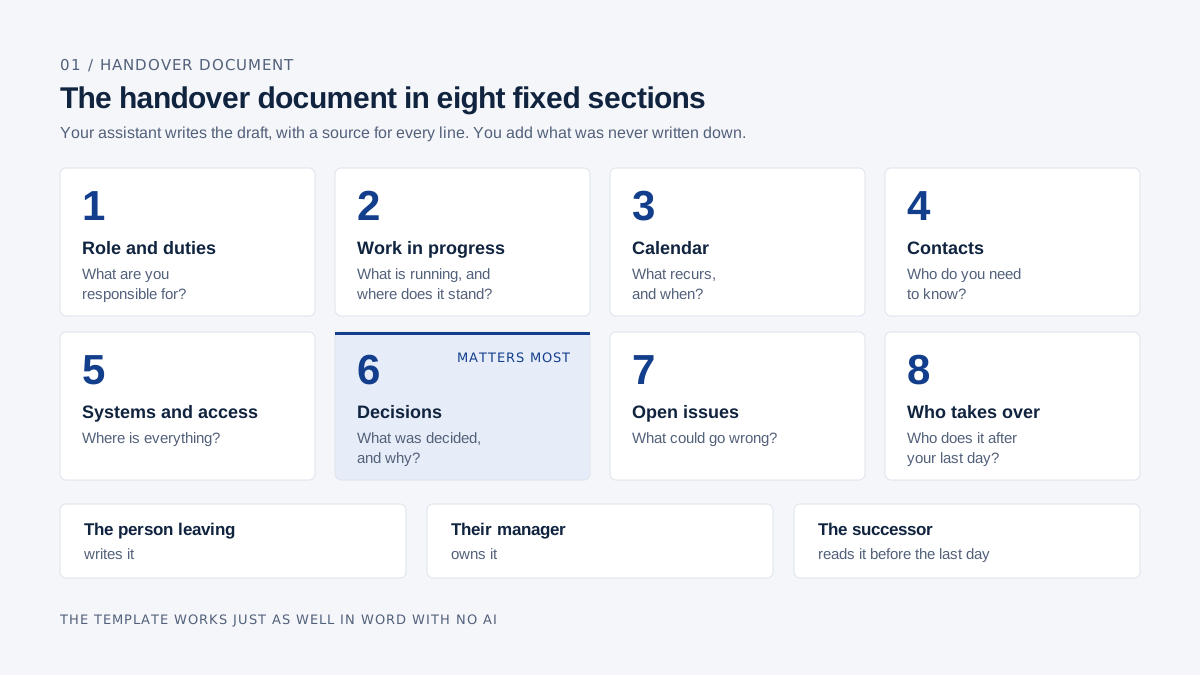
A good handover document answers eight questions, one per section. Here is the handover document in eight sections:
| # | Section | The question it answers | Typical content |
|---|---|---|---|
| 1 | Role and duties | What are you responsible for? | Responsibilities, authority |
| 2 | Work in progress | What is running, and where does it stand? | Status, next step, deadline |
| 3 | Calendar | What recurs, and when? | Recurring tasks, next date |
| 4 | Contacts | Who do you need to know? | Internal and external contacts |
| 5 | Systems and access | Where is everything? | Systems, permissions, folders |
| 6 | Decisions | What was decided, and why? | Decisions with the reasoning |
| 7 | Open issues | What could go wrong? | Open commitments, risks |
| 8 | Who takes over | Who does it after your last day? | A successor per section |
The section that matters most to me is decisions. Your successor can dig work in progress out of the inbox; the reasoning behind a decision is rarely there. Yet that is what they need in month three, when a supplier asks why last year's deal was different.
Handover document template (copy this)
Paste this into Word, Google Docs or your notes. Keep it short enough to read in one sitting: one line per project, with a pointer to the file instead of a copy.
Header: name and job title of the person leaving, last working day, manager (owner of the document), successor or interim cover, date and version.
- Role and duties. What are you responsible for, in three to five sentences? What authority do you hold: signing, budget, approvals? What do you do that isn't in your job description?
- Work in progress. One line per project or account: status, next step, deadline, who takes it over and where the file lives.
- Calendar. Everything that recurs, weekly, monthly, quarterly and yearly, with the next date after you leave and where the method is written down.
- Contacts. Per person: name, organisation, role and what your successor needs them for. Only what the work requires.
- Systems and access. Which systems and permissions, who transfers them and where the files live. List accounts in your own name with suppliers or portals, so they move to a role address. Passwords never go in the document; they go through IT or the password manager.
- Decisions. The decisions of the past year your successor will have to explain: what, when, why, which options were dropped and where it is recorded.
- Open issues. Commitments not yet delivered, risks you see coming, problems still running.
- Who takes over. Per section a name and a moment: a handover meeting, a day of shadowing, an introduction to a client or supplier. Plus whether you can be reached after you leave, if agreed.
Handover document example: a procurement manager
A fictional procurement manager at a fictional wholesaler; suppliers and dates are made up. This is what an AI draft looks like: every line with its source, and [FILL IN] where it is missing.
Header: procurement manager, last working day 31 January, owner: commercial director, successor: senior buyer, version 2 of 5 January.
| Section | Filled in |
|---|---|
| Role and duties | Buys five product groups and runs the annual agreements with twelve suppliers. Signs within the purchasing mandate. Not in the job description: the monthly stock report for the board. (source: job profile, mandate note) |
| Work in progress | Annual contract with supplier A: second offer received, decision due 20 January (source: email of 18 December). Trial with a new haulier runs until the end of February (source: purchasing meeting notes, 15 December). |
| Calendar | Every Monday: stock meeting. First working day of the month: stock report. Every quarter: price indexation with the five largest suppliers, next one in April. October: annual agreements. (source: calendar) |
| Contacts | Account manager at supplier A: negotiates on payment terms, not on price. Financial controller: wants the report in Excel. (source: email, notes) |
| Systems and access | Purchasing module of the ERP (permissions via IT). Supplier A and B portals: accounts in a personal name, to move to the role address. Contracts in the Purchasing/Contracts folder. |
| Decisions | In March, chose two suppliers instead of one for product group X, for continuity of supply after last year's shortages (source: decision memo, 12 March). |
| Open issues | Supplier B announced a price increase from 1 March [FILL IN: confirmed in writing?]. Damage claim against the haulier still open (source: email of 22 December). |
| Who takes over | Senior buyer: suppliers A and B, introductions in the second week of January. Financial controller: the stock report, from February. |
Project handover vs. handover when leaving a job
A project handover passes one project to a new project lead or to operations; a handover when leaving a job passes on a whole role. The template stays the same; the weight shifts.
| Project handover | Handover when leaving a job | |
|---|---|---|
| When | A change of project lead, or delivery to operations | After notice is given, before the last day |
| What moves | One project | A whole role: every project, task and relationship |
| Weight on | Work in progress, decisions, open issues | Calendar, contacts, systems and access |
| Extra in the document | Goal and scope, budget and spend to date, plan and milestones, what has been delivered, snag list | Authority, accounts in a personal name, availability after leaving |
| What usually goes missing | Why the scope changed along the way | What the person did that nobody knew about |
For a project handover, swap role and duties for goal and scope, and add budget and plan.
Job handover checklist: the notice period, week by week
Start the day notice is given. In the UK, gov.uk says you must give at least a week's notice if you've been in your job for more than a month; your contract may set a longer period. Even a month is tight. A plan that fits in four weeks:
- Week 1: the first draft, written by AI from email, calendar and notes. The manager decides who takes over what.
- Week 2: the person leaving fills every [FILL IN]. First handover sessions with the successor.
- Week 3: introductions to clients and suppliers, shadowing, moving accounts.
- Week 4: the final version, read by the successor, stored in a fixed place the company owns.
How do you write a handover document with AI?
You have an AI assistant draft it from your email, calendar and notes, and the person leaving checks every line and adds what's missing. Your assistant writes the draft, with a source for every line.
The prompt I use, for Claude, ChatGPT or your own assistant:
You're helping me write my handover document. I'm the [job title] and my last working day is [date]. Use these eight sections: role and duties, work in progress, calendar, contacts, systems and access, decisions, open issues, who takes over. Use only what is in my notes, email, calendar and meeting notes from the last twelve months. After every point, put the source in brackets, with its date. Don't make anything up: if an owner, date, amount or status is missing, write [FILL IN] and say what's missing. In the calendar, include everything that recurs, with the next date after my last day. For decisions, say why they were made, if the source says so. Leave out anything private from my email. End with the questions you need to ask me to close the gaps.
The source on every line makes it checkable, [FILL IN] makes the gaps visible, and the closing questions pull out the knowledge nobody wrote down.
With Claude or ChatGPT on their own, you can upload the files; ChatGPT allows file uploads on every personal plan (Free, Go, Plus and Pro), limited on Free, according to its pricing page. With the Microsoft 365 connector, Claude can read your Outlook email, calendar, OneDrive and SharePoint: read-only by default, on every plan. On Team and Enterprise an organisation owner has to switch it on first, and for work accounts a Microsoft admin grants a one-time consent. Checked on 16 November 2026.
In AI Board most of it is already there: meeting notes with decisions and owner-tagged actions, decision memos with the reasoning, files processed from the Inbox, plus email and calendar through Microsoft 365 or Google Workspace. The skill for Word documents turns the draft into a .docx with every gap highlighted in yellow.
AI can only summarise what is written down. Why you always give that one supplier an extra week isn't in any email. That comes out in conversations and voice notes; see how to capture tacit knowledge. And a summary can be wrong, which is why the person leaving checks every source.
Why a handover document isn't enough on its own
A handover document is a snapshot: it is accurate on the last working day and starts to age the day after. Your successor's hard questions only come in month three, when the person who wrote it has gone.
What keeps working is the source the document was written from, as long as it stays with the company. In AI Board that is the vault: plain markdown files on a company laptop, holding notes, meeting notes, decisions with the reasoning, client files and the skills, the saved methods and prompts. The successor can query it as if the person were still there: "Why did we pick two suppliers in March?" The answer comes back with its file.
So store that knowledge as company property, separate from Claude or ChatGPT. If your procurement manager's knowledge lives in her ChatGPT chats and her account's memory, it sits on a platform your company can't get into. What happens to chats and memory when someone leaves, I dig into in ChatGPT as a second brain. Plain files go with you to any model; what a second brain is, see a second brain for executives.
AI Board is personal, one vault per manager, so the handover only works if that vault, or the part about the work, stays with the company. Agree on that up front, at installation. With the Claude edition, a question is processed through Anthropic; with the local edition, that stays on your machine too (see security).
Can a handover document contain personal data?
Yes, but only what your successor needs to do the work. The European Commission, explaining Article 5(1)(c) of the GDPR, calls this data minimisation: personal data should be "adequate, relevant, and limited to what is necessary" for the purpose. An account manager's name, role and business contact details: yes. Remarks about someone's health or private life: no. Hence the line in the prompt about leaving private matters out.
What a handover document doesn't solve
A handover document, with or without AI, doesn't solve four things.
- Knowledge nobody wrote down, such as craft, a feel for a client or the reason behind a habit. That takes conversations and voice notes, long before anyone resigns.
- Relationships, because a document doesn't transfer trust. The person leaving introduces the successor to the clients and suppliers who matter.
- A messy source. Little in the email and notes means a thin draft.
- A departure without warning. With illness or an overnight exit, the document often never gets written, and you only have what was already there.
Frequently asked questions
What should be included in a handover document?
Eight sections: role and duties, work in progress, calendar, contacts, systems and access, decisions with the reasoning, open issues and who takes over. The header names the person leaving, the last working day and the successor.
Who writes the handover document?
The person leaving, because only they know what is going on. Their manager owns it, decides who takes over what and signs off the final version. The successor reads it while the author is still there.
How far ahead should you start a handover document?
The day notice is given. In the UK you must give at least a week's notice if you've been in your job for more than a month, according to gov.uk; your contract may set a longer period. Write the first draft in week one.
Can ChatGPT or Claude write a handover document?
Yes, a draft, from whatever you give it: uploaded files, or with Claude your email and calendar through the Microsoft 365 connector. Ask for a source on every line and [FILL IN] wherever something is missing. No AI can summarise what was never written down. Store the result where the company owns it, not only in someone's chat history.
What's the difference between a handover document and an offboarding checklist?
The offboarding checklist belongs to HR and IT: returning the laptop, closing accounts, the exit interview. The handover document is about the work: what is running, who takes it over and why it was decided that way. You need both.
AI Board is your personal AI assistant that makes you AI-native: it runs on your own laptop, grounded in your company's data, and gets sharper as your knowledge grows. Private by design, reasoning at CEO, CFO and CTO level, so you ride the AI wave instead of swimming behind it.