By Jordi Daniëls, founder of AI Board ·
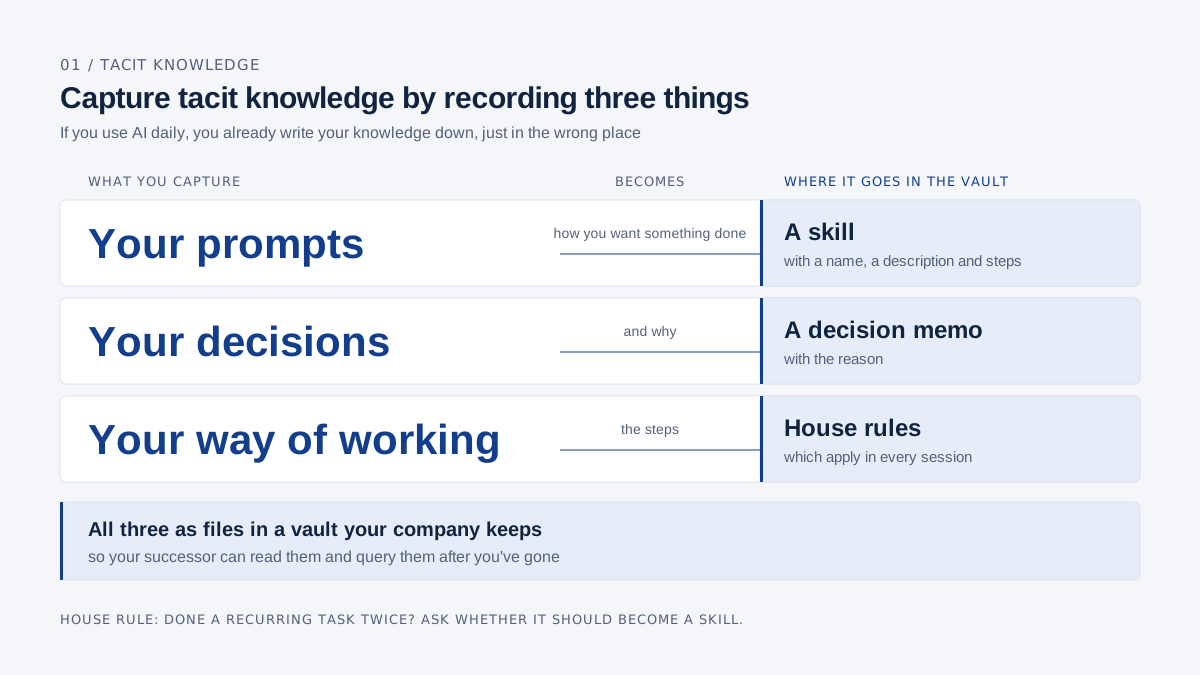
Tacit knowledge is what you know and use without it being written down anywhere, and you capture it by recording three things: your prompts, your decisions and your way of working. Your prompts (how you want something done) become a skill. Your decisions (and why) become a decision memo with the reason. Your way of working (the steps) becomes house rules. All three as files in a vault your company keeps, so your successor can read them and query them after you've gone.
How to handle the whole handover is in knowledge transfer when an employee leaves. A handover document records what someone does: tasks, open work, contacts. What the person leaving doesn't know they know never makes it into one.
Asking AI better questions is covered in prompt engineering for executives. Here it's about what you do with a good prompt after you've used it.
We sell AI Board, a personal AI assistant that sets up this kind of vault on your own laptop.
What is tacit knowledge?
Tacit knowledge is knowledge you use without putting it into words: experience, judgement, the exceptions to the rule. It's knowledge that is difficult to extract or articulate. The term comes from Michael Polanyi, whose The Tacit Dimension (1966) starts from one observation: "we can know more than we can tell" (University of Chicago Press).
The textbook example is riding a bike: you can do it, but you can't explain how you keep your balance.
Explicit knowledge is the opposite: knowledge already written down in a manual, contract, price list or dashboard, which you can pass on without its author in the room.
There's a middle layer I call latent knowledge: things you could put into words, but only do once someone asks the right question. That layer you can capture.
Tacit vs explicit knowledge: examples from a manager's week
Explicit knowledge lives somewhere and can be passed on without its author; tacit knowledge lives in someone's head and leaves with them. Examples from the work of a director or manager:
| Situation | Explicit: written down somewhere | Tacit: in your head | Where it goes in the vault |
|---|---|---|---|
| Pricing a quote | The price list and discount rules | When you depart from the price list, and why | A skill |
| A difficult customer | The contract and account details | That you phone before you email | The customer file |
| A supplier | The purchasing terms | Why you stopped using that supplier | A decision memo |
| Month-end close | Finance's checklist | Which figure you check first, because that's where it usually goes wrong | A skill |
| A new hire | The job description | What you do and don't hand over in the first weeks | The house rules |
Why does tacit knowledge disappear when someone leaves?
Tacit knowledge disappears because it was never written down: a handover document holds what the leaver knows they know, not what they take for granted. Three things make it worse.
It's unique to the individual. Panopto's 2018 Workplace Knowledge and Productivity Report, an online survey run with YouGov of 1,001 US employees at organisations with at least 200 staff, put the share of institutional knowledge that is "unique to the individual" at 42 percent: picked up for their current role and shared with none of their coworkers, according to Panopto's press release.
What's obvious doesn't get written down. Ask an experienced manager how they price a quote and they'll point to the price list. The exceptions they make every month only come out when you put a real quote in front of them.
The handover lands in the worst weeks. The leaver is wrapping up, and the successor often hasn't started yet.
How do you capture tacit knowledge?
You capture tacit knowledge by getting it into words while the person is still around, using real work. The best-known theory is Ikujiro Nonaka's SECI model, which he worked out with Hirotaka Takeuchi in The Knowledge-Creating Company (Oxford University Press, 1995). It has four steps: socialisation (watching and working alongside), externalisation (putting it into words), combination (sorting what's written down) and internalisation (doing it until it's second nature). In externalisation you make tacit knowledge explicit so others can share it.
In practice five methods work, each with a trap:
| Method | How it works | The trap |
|---|---|---|
| Shadowing | The successor works alongside the leaver for a few weeks | Nothing ends up on paper |
| Think aloud | The expert does a real task and says out loud what they're weighing up; you record it | Costs time from the busiest person |
| Exit interview | Ask about exceptions and decisions, not procedures | Comes late |
| Voice notes | A short recording after a meeting or decision | A recording nobody transcribes, nobody reads |
| Saving prompts | What you already explain to AI, you keep as a skill | Without a fixed home it stays stuck in a chat history |
Good exit interview questions are "When do you break the rule?" and "What would you make sure your successor knows in week one?". The question "What do you do all day?" only gets you a task list.
Tacit knowledge and AI: you're already writing it down
If you use AI every day, you're already writing your knowledge down, because a good prompt is exactly the explanation you'd otherwise never write. A prompt like "check this quote, watch the margin and the delivery time, and be critical" holds your judgement about what matters. That's externalisation, just in a window you close afterwards.
Capture three things, each in its own place:
| What you capture | Where it goes in the vault | What your successor can do with it |
|---|---|---|
| Your prompts: how you want something done | A skill: a file with a name, a description and steps | Have the same task done the same way |
| Your decisions: and why | A decision memo with the reason | Read why it went the way it did |
| Your way of working: the steps | The house rules, which apply in every session | Work by your rules |
From prompt to skill
A skill is a fixed way of working in a file: a name, a description of when to use it, and the steps, in plain language. In Claude, a skill is a folder with a SKILL.md file in which a name and a description are required. Unlike a prompt, which applies to one conversation, a skill loads when it's needed, so you don't have to repeat the same guidance every time. Anthropic describes the structure as "organized like an onboarding guide you'd create for a new team member" (Anthropic, Agent Skills, checked on 16 November 2026).
The quote prompt above looks like this as a skill (a made-up example):
| Part | Content |
|---|---|
| Name | quote-check |
| Description | Checks a quote before it goes out. Use for "check this quote". |
| Step 1 | Read the quote and the customer file in the vault. |
| Step 2 | Recalculate the margin against the floor in the house rules. |
| Step 3 | Put the delivery time next to the schedule and the payment terms next to the standard. |
| Step 4 | Return three points: what must change, what's a risk, what's fine. |
| Limit | Send nothing. You decide. |
When to turn a prompt into a skill is one line in the house rules of an AI Board installation, which in English reads: "Done a recurring task twice? Ask whether it should become a skill." The notes in the vault's Skills/ folder are the readable version, so even someone who doesn't use AI can see how you do it.
From decision to decision memo
You capture a decision with its reason attached, or a year later nobody knows why. AI Board's decision-memo skill puts a decision on one page: the decision in one sentence, the options (always including doing nothing), what each option costs and risks, the recommendation with its reasoning, and the strongest case against it. According to the skill itself, a busy person should be able to decide in five minutes and "defend the decision in six months". Once you agree, the memo is saved as a note in the Decisions/ folder, with the date in its name.
That's the difference between "we don't use that supplier any more" and "we stopped because they delivered late twice in our busiest weeks, and reliable delivery mattered more than price" (also made up).
From way of working to house rules
You capture your way of working in house rules: a file that applies in every session, so the assistant doesn't have to guess how you work. AI Board's default house rules say, for example, that emails and messages are drafts you send yourself, and that figures come straight from the source, with the source and the date. Below them you add your own: how you write, what you never do, what you always check first.
Voice notes: latent knowledge without typing
The easiest way to capture latent knowledge is to say it out loud. After a customer meeting or a decision, you record a note in Obsidian. AI Board's voice notes routine transcribes those recordings locally with whisper.cpp, so no audio goes to the cloud, and turns them into one note per topic, with your own actions on the board. You only need to talk while it's still fresh.
Why should those files belong to your company?
Captured knowledge only helps your successor if it sits somewhere the company owns, not in the chat history of someone's ChatGPT or Claude account. A chat belongs to an account on a platform. What happens to those chats when someone leaves, I look into with sources in ChatGPT as a second brain.
The vault is an ordinary folder of plain markdown files on a company laptop. You can read it without the tool and hand it to a different model tomorrow. Files on your own disk aren't the same as processing on your own disk, though: with the Claude edition a question is processed through Anthropic, with the local edition that stays on your machine too (see security).
If the vault stays with the company, the successor can query it as if the leaver were still around: "Why did we stop using that supplier?" The answer comes with the file it came from, so you can check it. More on how such a vault works is in a second brain for executives; on a setup day we set it up with you.
Can you capture all tacit knowledge?
No. A review quoted on the page of Polanyi's publisher puts it plainly: all knowledge has personal and tacit elements, so it can never be made fully explicit. Three kinds stay behind:
- Craft in the fingertips. How an experienced salesperson lets a silence sit isn't something you learn from a file.
- Relationships. A customer file helps the successor open the conversation; the trust they have to build themselves.
- Intuition you can't put into words yourself. If you don't know why something feels off, no skill can write it down.
And a skill is only as good as the person who wrote it. Capture a bad habit and it now runs exactly the same way every time. A vault doesn't fill itself either, and whatever goes in sloppy comes out sloppy. A summary from the assistant can be wrong, so always keep the original.
If your business runs mostly on hands-on work, in a workshop or on a building site, shadowing and showing beat files.
Frequently asked questions
What is tacit knowledge?
Tacit knowledge is knowledge you use without putting it into words: experience, judgement and the exceptions to the rule. Michael Polanyi described it in The Tacit Dimension (1966) as the fact that we can know more than we can tell. It's also called implicit knowledge.
What is the difference between tacit and explicit knowledge?
Explicit knowledge is written down somewhere, in a manual, contract or price list, and can be passed on without its author. Tacit knowledge lives in someone's head, like why you stopped using a supplier. It leaves when the person leaves.
What are examples of tacit knowledge?
A director who knows when to depart from the price list on a quote, and why. No price list says that. Or the controller who always checks one particular figure first in the month-end close, because that's where it usually goes wrong.
How do you capture tacit knowledge?
By getting it into words while the person is still around: shadowing, thinking aloud, an exit interview and voice notes. If you work with AI, turn good prompts into skills, decisions into decision memos with the reason, and your way of working into house rules.
Can AI capture tacit knowledge?
Yes, the part you put into words. A good prompt is knowledge already made explicit: save it as a skill in a vault your company keeps and it keeps working after you've gone.
Should you save your prompts?
Yes, the ones you use more than once. A prompt you retype comes out slightly different each time and disappears into a chat history. Saved as a skill, with a name, a description and steps, it works the same way every time.
AI Board is your personal AI assistant that makes you AI-native: it runs on your own laptop, grounded in your company's data, and gets sharper as your knowledge grows. Private by design, reasoning at CEO, CFO and CTO level, so you ride the AI wave instead of swimming behind it.