By Jordi Daniëls, founder of AI Board ·
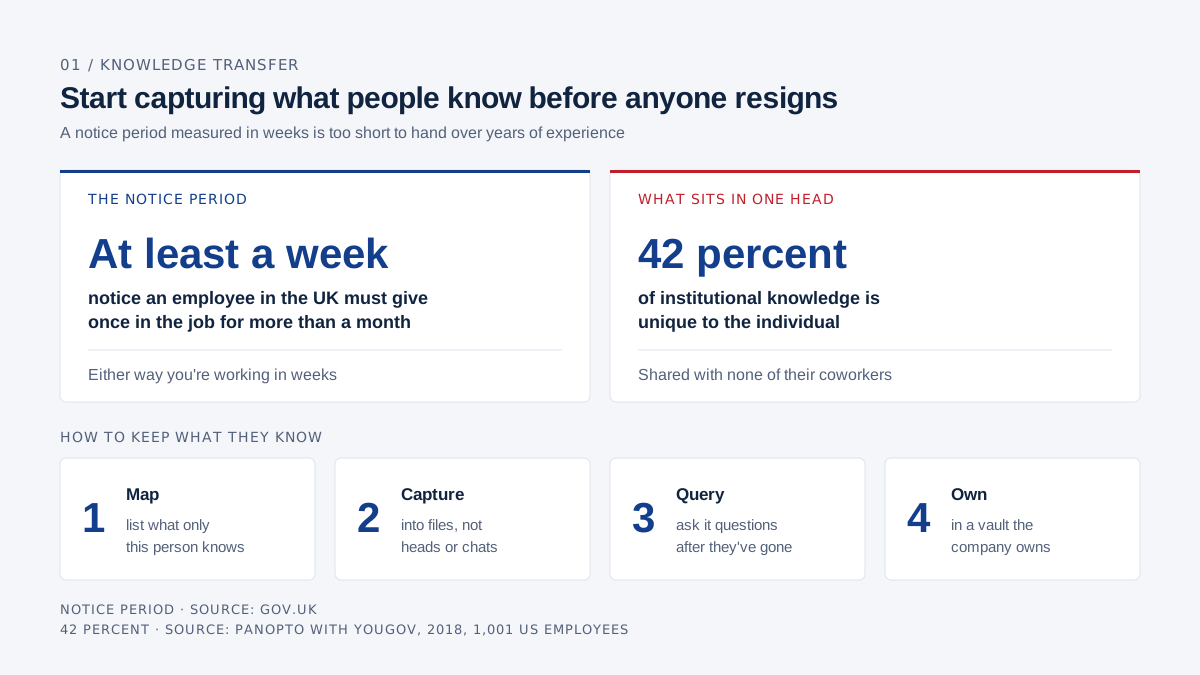
Knowledge transfer when an employee leaves comes down to four steps: map, capture, query and own. Map: list what only this person knows. Capture: get it into files, not heads or chats. Query: make sure you can ask it questions after they've gone. Own: keep it in a vault the company owns. Start before anyone resigns, because a notice period measured in weeks is too short to hand over years of experience.
A strong performer hands in their notice, and only in the weeks after do you find out how much lived in that one head: why a client is on a different pricing deal, how the quarter-end close actually runs, which supplier you never call on a Friday afternoon.
The handover document, with a template, capturing tacit knowledge and why company knowledge shouldn't live in ChatGPT or Claude each have their own article.
AI Board makes a personal AI assistant whose second brain is built for exactly this problem. Every number below links to its source.
What is knowledge transfer?
Knowledge transfer is the process of passing what one person knows, including their experience and ways of working, to someone else or to the organisation, so the work carries on once that person is gone. In a corporate setting it comes up at resignations, retirements and internal moves.
Two kinds of knowledge are involved:
- Explicit knowledge is already written down somewhere: a procedure, a contract, a price list. You hand it over by pointing at where it lives.
- Tacit knowledge lives in someone's head: how they price a bid, who they call when a delivery stalls. The philosopher Michael Polanyi put it this way in The Tacit Dimension (1966): "we can know more than we can tell".
Knowledge transfer almost always fails on the second kind; how to get it out of people's heads is the subject of capturing tacit knowledge.
Why does knowledge walk out the door when someone leaves?
Knowledge is lost when someone leaves because most of it was never written down, because the handover only starts when the resignation letter lands, and because what was written down often sits somewhere that leaves with the person.
Most of it sits in one head. Panopto's 2018 Workplace Knowledge and Productivity Report, an online survey run with YouGov of 1,001 US employees at organisations with at least 200 staff, put the share of institutional knowledge that is "unique to the individual" at 42 percent: picked up for their current role and shared with none of their coworkers, according to Panopto's press release. The same workers spent an average of 5.3 hours a week waiting for help or insight from colleagues. That's with the colleague still in the building; once they've left, there's nobody left to ask.
The notice period is short. In the UK, an employee must give at least a week's notice once they've been in the job for more than a month, according to GOV.UK, which also tells you to check your contract. In the Netherlands, where I'm based, the default for an employee on a permanent contract is one month, and an agreed longer period can't exceed six months, according to the Dutch government and article 7:672 of the Dutch Civil Code. Either way you're working in weeks, minus any holiday still to be taken. That's too short for ten years of experience.
Leaving is routine. The median US wage and salary worker had been with their current employer for 4.1 years in January 2026, according to the Bureau of Labor Statistics. Half had been there for less.
What was written down is in the wrong place. Knowledge sits in someone's inbox, in a folder on their own laptop, and more and more in their personal AI chats. ChatGPT keeps saved memories and can reference past chats, according to OpenAI's Memory FAQ. Claude can remember context from your chats, and each project has its own memory, according to the Claude Help Center (both checked on 16 November 2026). If someone built their best prompts and the background on their clients inside their own account, all of that leaves with them. What actually happens to chats, projects and memory when someone leaves is covered in ChatGPT as a second brain.
How do you build a knowledge transfer plan?
A knowledge transfer plan is a list of what the leaver knows, who takes over each part, how it gets handed over and by when, spread across the notice period in the four steps from the answer at the top.
- Map. In the first few days, list the recurring tasks and how often they come round, open projects and pending decisions, clients and suppliers with the contact person, systems and access, and the exceptions nobody wrote down. Two questions help: "What do you do that nobody else knows?" and "Where will your successor get stuck in month three?" Put a successor's name against every line.
- Capture. Get it into files: a handover document for the list, recordings or voice notes for the stories and exceptions, and a short note for each important decision with the reasoning behind it. What goes in the document, with a template, is in handover document template.
- Query. Have the successor ask the files their own questions while the leaver is still around. Every question the files can't answer is a gap you can still close. This step is the only real test of the handover.
- Own. Put everything somewhere the company owns, so not in a personal folder or a private ChatGPT account. Sort out access to systems, the mailbox and shared files, and agree who maintains it.
With a one-month notice period, it looks like this:
| When | Step | What you have at the end |
|---|---|---|
| Days 1 to 3 | Map | A list of tasks, open work, contacts, systems and exceptions, with a successor against each line |
| Weeks 1 to 3 | Capture | A handover document, recorded knowledge transfer sessions, shadowing days, decisions with their reasoning |
| Weeks 3 and 4 | Query | The successor has asked the files their own questions; the gaps are filled |
| Final days | Own | Everything sits somewhere the company owns; access and ownership have moved |
Start with whatever touches a client or a number. Internal inconvenience can wait.
What does a good knowledge transfer session look like?
A knowledge transfer session is a block of about an hour in which the leaver walks the successor through one topic using real work, recorded and written up as a note the same day. One topic per session, not "everything about finance".
- Show the work. Open the actual proposal or spreadsheet. People looking at their own work mention the exceptions unprompted.
- Ask why. "Why do you do it this way?" and "What went wrong once?" get you further than "What do you do?"
- Record it, with consent, and write it up as a note. A recording on its own is hard to find again.
- Have the successor explain it back. Whatever they can't put in their own words hasn't transferred.
Which knowledge transfer methods work, and what do they miss?
The common knowledge transfer methods are shadowing, a handover document, knowledge transfer sessions, recordings or voice notes, mentoring and a decision log. Each catches a different kind of knowledge, which is why you combine them.
| Method | What it catches | What it misses |
|---|---|---|
| Shadowing | How someone works in real situations, the moves they no longer notice themselves | Only what comes up during those days; nothing remains if the successor leaves too |
| Handover document | Tasks, open work, contacts, systems and access | The reasoning behind decisions; it goes stale the day it's finished |
| Knowledge transfer sessions | One topic explained, with the successor's questions | Whatever doesn't come up; without a recording it lives only in the heads of those present |
| Recordings and voice notes | Stories, reasoning and exceptions in the person's own words | Hard to find again until someone writes it up |
| Mentoring | Judgement and craft, built up over months | Doesn't fit into a notice period of a few weeks |
| Decision log | Why something was decided, and which options were on the table | Only works if it was kept during the work, not reconstructed afterwards |
| Working methods as files | How recurring work gets done step by step, including the prompts someone uses | Only what repeats; one-off situations fall outside it |
The best-known model behind this comes from Ikujiro Nonaka and Hirotaka Takeuchi. Their SECI model, set out in The Knowledge-Creating Company (Oxford University Press, 1995), describes four ways knowledge changes form (summary on Wikipedia):
- Socialisation: tacit to tacit. Shadowing and working side by side.
- Externalisation: tacit to explicit. Writing it down, talking it through, explaining.
- Combination: explicit to explicit. Merging and organising documents.
- Internalisation: explicit to tacit. The successor learns it by doing it.
When someone leaves, externalisation is what counts: whatever doesn't move from head to file during the notice period is gone.
How do you build knowledge retention into everyday work?
Knowledge retention means capturing knowledge while the work happens, somewhere the company owns, so that a resignation never turns into a rescue operation. A knowledge transfer plan saves what it can when someone leaves; with knowledge retention there's little left to save.
In practice it comes down to four habits:
- Every meeting becomes a note with the decisions, the actions and who owns each one.
- Every important decision gets its reasoning. A year from now nobody will remember why you picked that supplier, unless it's written down.
- Every recurring task becomes a written method. Do something for the second time, write down how. That includes the prompt you paste into ChatGPT every Monday.
- Everything lives in one place the company owns, not scattered across personal folders, inboxes and chat accounts.
To check whether it works, ask one question: could someone else take over your work tomorrow with only the files? Writing things down takes time exactly when you don't have it. That's where AI helps, as long as the knowledge doesn't end up stuck inside the AI.
How does AI Board's second brain handle knowledge transfer?
AI Board captures knowledge in plain markdown files in a vault the company owns, and lets you query it with AI, even after the person who wrote it has gone. For what a second brain is in the first place, see a second brain for executives.
The vault is an ordinary folder of plain text files (an Obsidian vault) on a laptop. What goes in maps onto the four habits above:
| What the leaver knows | Where it lives in the vault |
|---|---|
| What was agreed in meetings | A note per meeting with decisions and actions, each action with an owner and the quote behind it |
| Why something was decided | A one-page decision memo: the options, the trade-offs, the recommendation with its reasoning |
| What's in decks, memos and spreadsheets | A note per file with a summary, decisions and actions; the original is kept |
| How recurring work gets done | Skills: written working methods and saved prompts, as files in the vault |
| Style, rules and preferences | House rules in a file that applies to every session |
| Stories and exceptions | Voice notes, transcribed locally, one note per topic |
Capture happens during the work. From a meeting transcript, the assistant pulls the decisions and actions, with an owner and the quote each one came from; anything nobody said out loud stays unassigned instead of being guessed. A decision can become a decision memo, so you can still defend it six months later. Voice notes are transcribed locally with whisper.cpp, and no audio goes to the cloud. Ten minutes a week talking through a live client account retains more than a handover document written in the final week.
Prompts and working methods become files. A prompt someone uses every week becomes a skill: a written method in the vault, readable by a person and usable by the assistant. The house rules of every installation include one that says, in effect: done a recurring task twice, ask whether it should become a skill. That way the method sits in a file that stays when someone leaves.
The vault can be queried after the person has gone. The successor, or you, asks the vault questions as if the leaver were still there. A made-up example, with invented names:
- "Why did we pick supplier X over Y in March?" The assistant finds the decision memo and the meeting note, and gives the reasoning that was written down at the time.
- "How did Sandra run the quarter-end close?" The assistant opens the skill Sandra used and walks you through the steps.
- "What's still open with client Y?" The assistant reads the latest meeting notes and the board, and lists the open actions with their owners.
Every answer comes with its source, the file it's in, so you can check it before you repeat it.
It doesn't depend on one model. Plain files can be read without the tool that wrote them, moved to another machine and handed to a different model next year, for example a local model alongside Claude. That sets them apart from the chats and memory in someone's ChatGPT or Claude account: those belong to an account, and that account isn't your company.
The files sit on your own laptop. Choose the Claude edition of AI Board and a question is processed via Anthropic; choose the local edition and that stays on your machine too. That's spelled out on the security page, and the difference is explained in private AI on your laptop. Point the same setup at the whole organisation and you have a company brain.
What a vault can't capture
A vault only catches what was written, recorded or spoken.
- Relationships don't transfer through a file. A client who has called the same account manager for ten years trusts that person. That takes a warm introduction before the leaver goes.
- Hands-on craft stays human. How an engineer hears that a machine is running wrong doesn't fit in markdown. Shadowing and mentoring are still needed.
- A vault nobody filled answers nothing. If capture starts with the resignation letter, you get a month of files, not years.
- Summaries can be wrong. A note the assistant made from a document is derived. That's why the originals are kept and every answer shows its source.
- It's set up per person. AI Board is a personal assistant per manager, not a chatbot for the whole team. The handover only works if the leaver's vault, or the shared part of it, belongs to the company and stays with the company. Agree that up front, along with what counts as private.
A second brain makes capture and query lighter; you still need a knowledge transfer plan.
Read next
- Handover document template: what goes in the document, and how AI drafts it.
- How to capture tacit knowledge: catching what nobody writes down, such as prompts and decisions.
- ChatGPT as a second brain: what happens to work knowledge in ChatGPT or Claude when someone leaves.
Frequently asked questions
What is knowledge transfer?
Passing what one person knows, including their experience and ways of working, to a successor or the organisation, so the work carries on once they're gone. The hard part is tacit knowledge: what lives only in someone's head.
How do you create a knowledge transfer plan when an employee leaves?
In four steps: map what only this person knows and who takes over each part, capture it in files, query those files by having the successor ask questions while the leaver is still there, and own the result by keeping it somewhere the company controls. Spread the steps across the notice period.
What are the main knowledge transfer methods?
Shadowing, a handover document, knowledge transfer sessions, recordings or voice notes, mentoring and a decision log. You combine them.
How do you improve knowledge retention?
By capturing knowledge during the work rather than at the exit, in one place the company owns: meeting notes, decisions with their reasoning, and written methods.
How long should knowledge transfer take?
Usually as long as the notice period, which is often a few weeks: in the UK the legal minimum is a week once someone has been in the job for over a month, and in the Netherlands the default is one month. That's enough for a list and a handover document, not for years of experience.
Can AI help with knowledge transfer?
Yes, in capture, because AI turns a meeting or document into a note with decisions and actions, and in query, because the successor can ask the files questions. The knowledge does have to sit in files the company owns, not in someone's personal ChatGPT or Claude account.
AI Board is your personal AI assistant that makes you AI-native: it runs on your own laptop, grounded in your company's data, and gets sharper as your knowledge grows. Private by design, reasoning at CEO, CFO and CTO level, so you ride the AI wave instead of swimming behind it.